Episode 6 – The Transatlantic Hothouse (1960–1964)
This is Episode 6 of Vin Amorando’s History of Rock series, examining the British Invasion as a transatlantic feedback system rather than a simple British conquest of American popular music. American rhythm and blues, rock and roll, girl-group arrangements, Motown, Chuck Berry, and Chicago blues crossed into Britain, where musicians including the Beatles and Rolling Stones transformed that material through their own performance histories and musical identities. Brian Epstein and Andrew Loog Oldham then built sharply different commercial propositions around those bands. When approximately 73 million Americans watched the Beatles on The Ed Sullivan Show on February 9, 1964, they encountered something genuinely new that still carried American musical lineage inside it. The achievement was real, but so was the institutional inequality that gave British groups mainstream access on a scale many of their Black American sources had never consistently received.
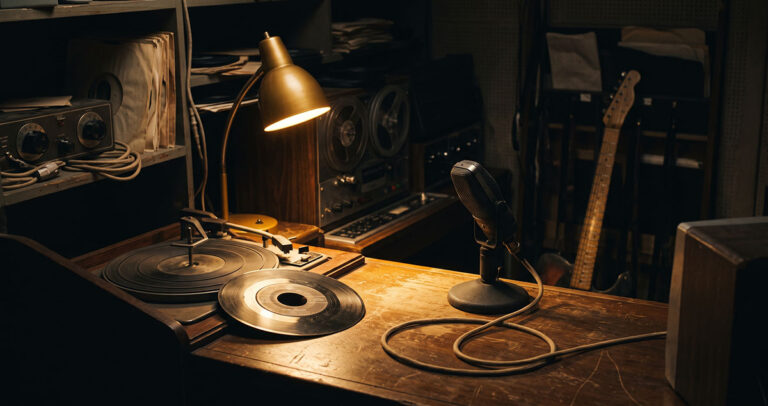
In 1962, the raw material for one of the largest shifts in popular music could still fit inside a paper sleeve. American rhythm and blues records crossed the Atlantic aboard ships, entered British ports, and passed through specialist shops and private collections into rooms where young musicians played them repeatedly. The records carried songs, but they also carried systems: ways of placing a backbeat, arranging voices, attacking a guitar phrase, compressing a social observation, and creating tension through rhythm.
Britain gave those records an unusual receiving environment. Postwar austerity still shaped everyday life, and class remained a practical limit on what many teenagers expected from adulthood. The country’s expanding art-school network gave some young people a route outside conventional academic and industrial paths. These weren’t conservatories. They were places where style, fashion, visual culture, and performance could be treated as materials to be manipulated rather than inherited intact.
British broadcasting created another condition: scarcity. The BBC monopoly, institutional programming priorities, and restrictions on recorded music meant that younger listeners couldn’t simply hear as much American popular music as they wanted. The gatekeepers hadn’t intended to produce musical obsession, but scarcity increased the value of everything that got through. Restriction concentrated attention.
The BBC’s attempt to suppress American R&B through bureaucratic restriction created one of the most motivated audiences of musical scholars Britain had produced.
The Shadow Supply Chain

What domestic broadcasting didn’t supply, informal networks did. Records entered Britain through Liverpool, London, and other ports, then circulated among shops, collectors, musicians, and clubs. A record that might have been one release among thousands in the United States could acquire unusual weight once it crossed the Atlantic because replacing it wasn’t necessarily easy.
Young musicians listened accordingly. At places such as the Crawdaddy Club in Richmond, American blues and R&B functioned as working material. Players listened for stop-time figures, vocal call-and-response, guitar phrasing, bass movement, and the relationship between an arrangement and its physical effect on a room. The record wasn’t background entertainment. It was evidence.
Scarcity encouraged concentration. When a musician didn’t have immediate access to an endless catalog, the available record had to keep yielding information. Repetition became analysis, and recordings often served as the teachers that circumstance hadn’t provided in person.
That distinction matters. British musicians weren’t simply consuming American popular culture from a distance. They were building a working vocabulary from it.
What They Did with What They Found
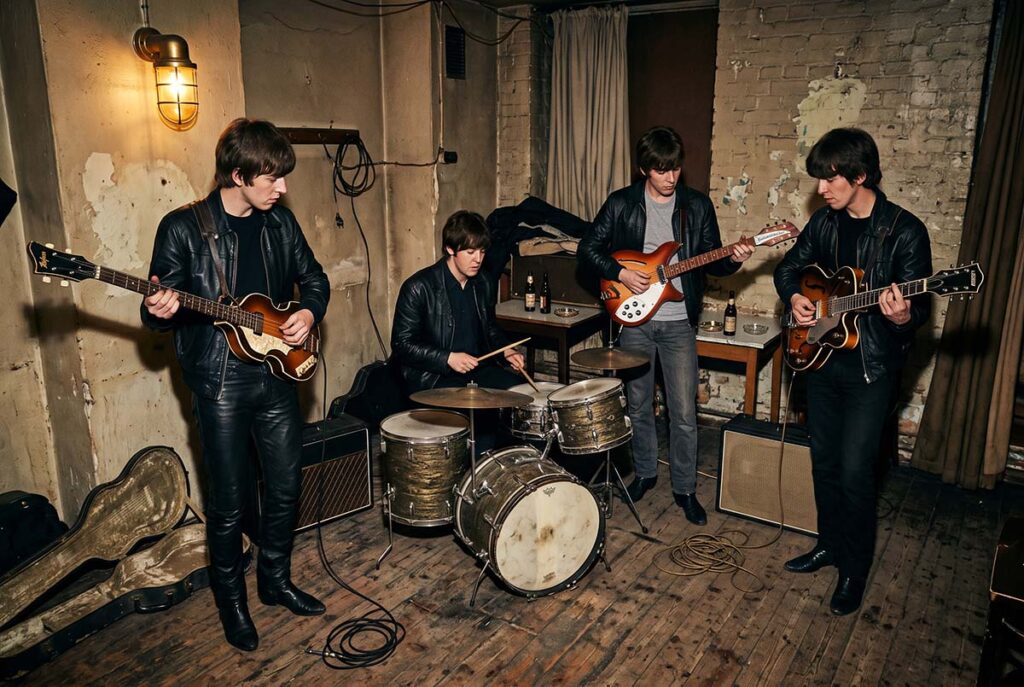
The Beatles demonstrate how far that process could travel because the range of American material they absorbed was so broad. Girl-group arrangements, rock and roll, R&B, vocal harmony, Motown, and Chuck Berry all entered their education. The Shirelles offered lessons in the interaction between a lead voice and answering background parts. Berry supplied another kind of compression: a guitar figure or a few verses capable of carrying an entire social scene.
These sources functioned less like decorative influences than blueprints. The crucial next stage came through performance, particularly in Hamburg, where the Beatles played marathon sets in the Reeperbahn clubs. Material learned from records had to survive exhaustion, volume, repetition, impatient audiences, and the simple test of whether it still worked after hours onstage.
That process made imitation unstable. American material passed through the band’s voices, bodies, humor, limitations, instincts, and ambitions. By the time the Beatles emerged from those residencies, command of American forms had become part of a recognizably different musical identity. Their originality doesn’t disappear because the lineage can be traced. The lineage explains part of how the originality became possible.
The Beatles mastered American music Britain had already imported, much of it distributed unevenly by the American institutions that had produced the records in the first place.
The Rolling Stones developed through overlapping material but made a different proposition from it. Their attachment to Chicago electric blues and R&B was more explicit, with figures such as Muddy Waters and Chuck Berry close to the center of their early musical identity. Flattening the Beatles and Stones into the same story of “American influence” misses precisely what makes translation interesting. Similar source material can produce sharply different outcomes.
Translation preserves something, and translation changes something.
The Two Managers and Their Products
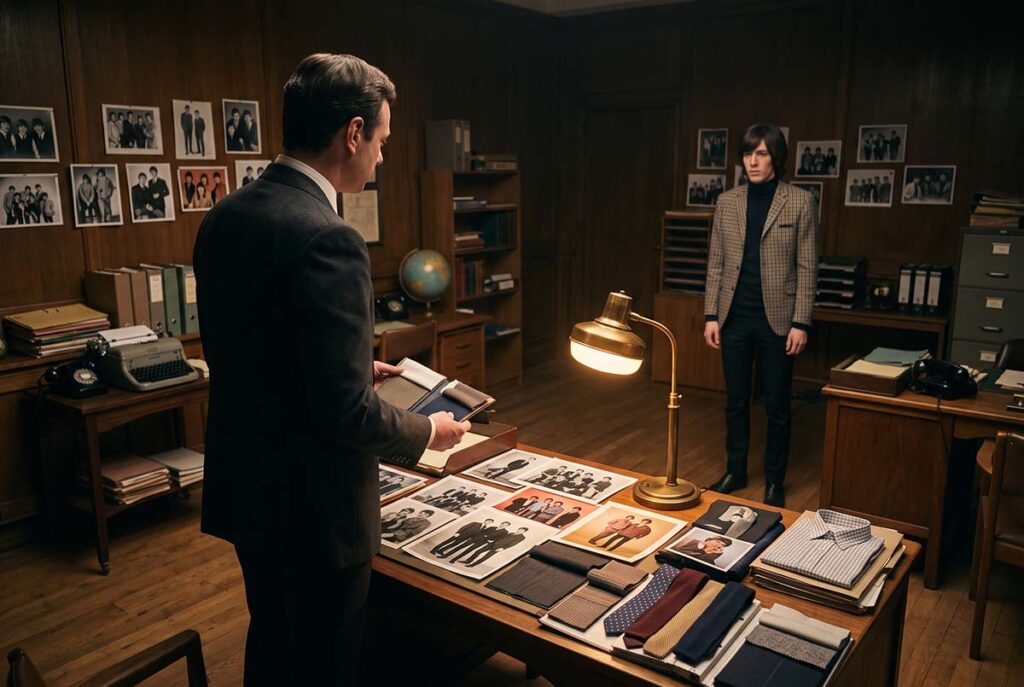
Brian Epstein entered the Beatles’ story through retail. When he saw them at Liverpool’s Cavern Club in November 1961, he encountered substantial musical experience alongside a presentation that belonged to the underground club economy. Epstein professionalized the operation. Scheduling tightened, stage behavior changed, leather gave way to coordinated tailoring, and the band became easier for promoters, broadcasters, and larger audiences to read.
Calling that process simple sanitization strips the musicians of too much agency. Epstein didn’t create their musical ability, their appetite for American records, or the experience accumulated through years of performance. He altered the interface between the musicians and the institutions capable of distributing them. The music remained theirs. The gatekeepers became more willing to open the door.
Andrew Loog Oldham recognized the commercial space Epstein’s success had created. If the Beatles occupied disciplined charm, the Rolling Stones could occupy danger. Their commitment to blues and R&B preceded Oldham, but he understood how effectively parental suspicion could be turned into publicity.
The provocation asking whether parents would allow a daughter to marry a Rolling Stone worked because outrage itself circulated the product. By 1963, rebellion didn’t have to resist marketing to become powerful. Rebellion could be the marketing.
The two managers therefore offered different commercial translations of genuine musicianship. Epstein made unruly talent legible to established institutions. Oldham made unruliness itself legible as a commercial category. Neither outcome makes the music underneath fraudulent.
Rock would spend decades pretending authenticity and commercial construction were opposites. They rarely were.
Breaking the Monopoly

By early 1964, Britain’s appetite for continuous recorded popular music had become too large to remain confined to clubs, imported records, and restricted airtime. Radio Caroline began regular offshore broadcasting in March, operating outside the normal domestic broadcasting structure and giving young listeners more of the music they were already demanding.
Its dramatic setting makes pirate radio easy to misread as the source of the British Invasion. The chronology says otherwise. The Beatles and Rolling Stones already existed, their musical education had already taken place, and much of the underground network that sustained them had been functioning for years.
Radio Caroline mattered because it exposed scale. British teenagers had already built a market through imported records, clubs, touring musicians, alternative listening routes, and personal networks. The ship turned that appetite into a continuous signal.
Pirate radio didn’t create the hothouse. It showed that the hothouse had outgrown its walls.
The Ed Sullivan Paradox
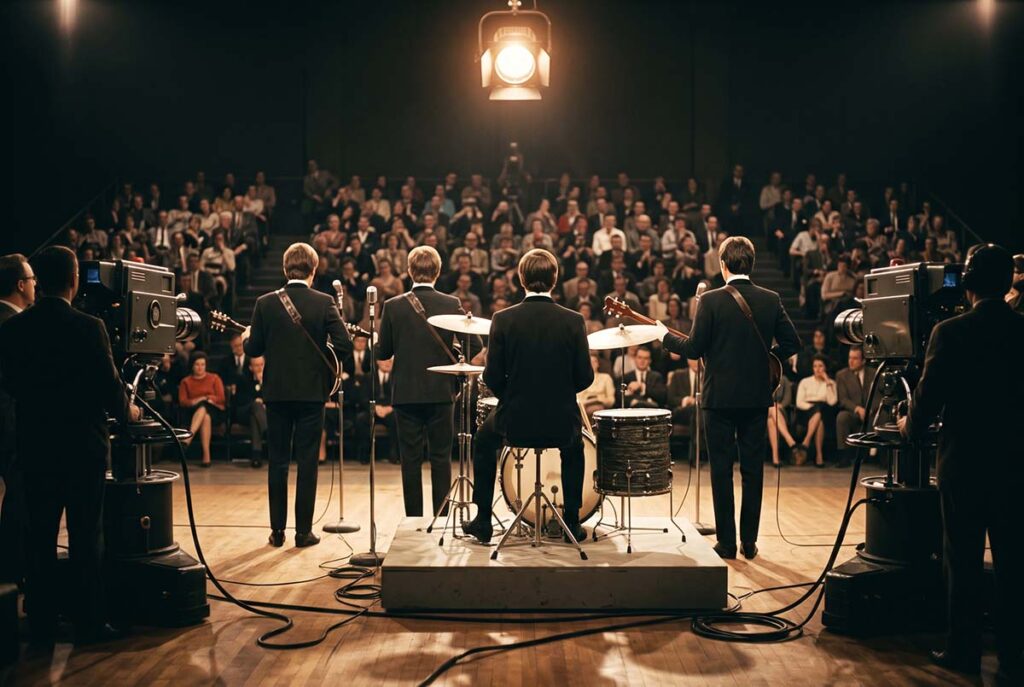
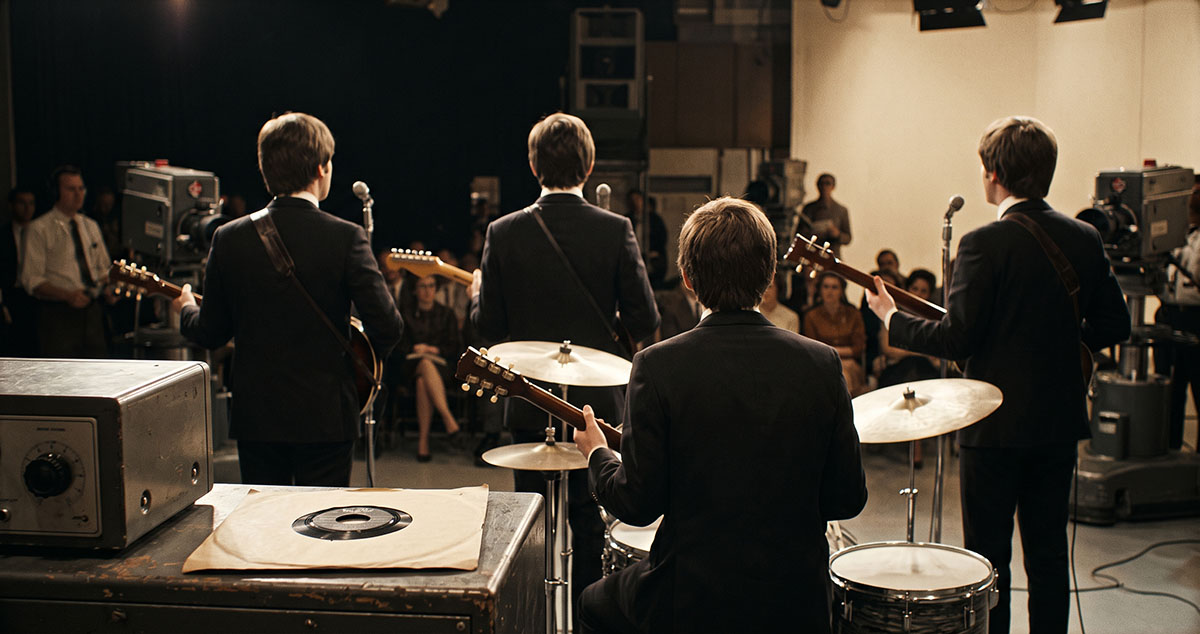
On February 9, 1964, approximately 73 million Americans watched the Beatles perform on The Ed Sullivan Show. The size of the audience transformed a long transatlantic exchange into mass culture almost instantly. A process that had unfolded through docks, record shops, clubs, rehearsal rooms, Hamburg stages, managers, and publicity machinery now occupied American television.
Popular memory names the night as an invasion. Four young men from Liverpool appeared on American screens and seemed to announce that Britain had discovered popular music’s future before America did. Yet much of the musical vocabulary entering those living rooms had previously crossed the Atlantic in the opposite direction.
That doesn’t make the Beatles reducible to their sources. Their chemistry, songwriting, performance discipline, humor, ambition, and musical decisions produced something distinctly their own. Originality and lineage can occupy the same record. The existence of one doesn’t cancel the other.
What Americans heard that night had passed through several layers of translation. Girl-group vocal architecture, Chuck Berry’s guitar vocabulary, rhythm and blues, rock and roll, and other American materials had moved through British listeners, musicians, clubs, Hamburg residencies, management, tailoring, publicity, and television strategy. By the time they returned, they had changed enough to be experienced as foreign.
American music left. Britain studied it, disciplined it, branded it, and shipped it back. America paid for the return.
What the British Invasion Erased
The consequences extended beyond Beatlemania because the industry’s idea of a valuable artist changed. Once the Beatles became a commercial phenomenon, the self-contained group looked like the future. A band that wrote songs, played instruments, performed together, and carried a coherent public identity suddenly represented an extremely attractive business model.
That shift weakened the prestige of an older division of labor. The Brill Building system had connected professional songwriters, producers, singers, arrangers, and session musicians to produce enormous amounts of American popular music. It had also carried its own inequalities, particularly in the relationship between Black musical language, white commercial infrastructure, authorship, control, and reward.
The Brill Building apparatus the British Invasion displaced was itself a system in which white professional songwriters frequently worked inside Black-derived musical idioms for a mass market. The industry didn’t abandon some untouched age of authenticity when it pivoted toward self-contained groups. It traded one form of extraction for another.
Episode 5 had already exposed one part of that machinery through Phil Spector, Ronnie Spector, the Ronettes, and the unequal ownership structures surrounding the girl-group era. The British Invasion altered the commercial architecture without solving the underlying question: who could convert culture into property, and who would keep the rewards after the conversion?
As labels redirected attention and capital toward white self-contained groups, R&B and soul artists faced a changing commercial environment. That doesn’t make the Beatles personally responsible for the inequality, and it doesn’t reduce British musicians to thieves carrying an intact culture across an ocean. The harder finding concerns institutions.
America possessed much of the musical inheritance. Britain built new forms from it. American institutions recognized more of its commercial power once those forms came back wearing British faces.
The achievement and the displacement belong to the same story. Removing either one produces cleaner mythology and worse history.
America didn’t need to be taught to love this music. It needed to be taught that it already had.
Frequently Asked Questions
What did the British Invasion actually establish about the origins of British rock?
The British Invasion showed that British rock developed through sustained engagement with American music rather than independently from it. British musicians absorbed rhythm and blues, rock and roll, girl-group arrangements, Motown, Chicago blues, and related forms, then transformed that vocabulary through British clubs, live performance, management, fashion, and their own musical identities.
Why was the Beatles’ February 9, 1964 Ed Sullivan appearance so important?
Approximately 73 million Americans watched the Beatles on The Ed Sullivan Show that night. The scale turned a long transatlantic exchange into American mass culture. Musical ideas that had traveled from America to Britain returned through a British group whose sound was genuinely original while still carrying recognizable American musical lineage.
How were the Beatles and Rolling Stones influenced differently by American music?
The Beatles absorbed an unusually broad range of American material, including girl groups, rock and roll, rhythm and blues, vocal-group harmony, Motown, and Chuck Berry. The Rolling Stones built their early identity more explicitly around Chicago electric blues and R&B, placing figures such as Muddy Waters and Chuck Berry closer to their public musical proposition.
What did Brian Epstein and Andrew Loog Oldham actually do for their bands?
Brian Epstein professionalized the Beatles through disciplined scheduling, coordinated presentation, altered stage behavior, and an image that existing institutions could understand. Andrew Loog Oldham positioned the Rolling Stones differently by amplifying danger and parental suspicion. Neither manager created the musicianship underneath those identities, but both understood how public identity could affect market access.
Did Radio Caroline cause the British Invasion?
No. Radio Caroline began regular offshore broadcasting in March 1964, after the Beatles and Rolling Stones had already developed their musical identities. Its importance was different: the station revealed how large British demand for continuous popular music had become and showed that existing broadcasting structures could no longer contain that appetite.
What does the episode mean by the British Invasion changing one form of extraction for another?
The British Invasion weakened an older commercial model built around professional songwriters, producers, singers, and session musicians, but it didn’t eliminate unequal ownership or access. The self-contained guitar group became a new commercial ideal while older questions about race, authorship, institutional power, and who received the rewards remained unresolved.
Was the British Invasion cultural theft or genuine musical innovation?
The evidence doesn’t support either simple answer. The Beatles and Rolling Stones genuinely transformed what they learned through their own voices, instruments, performance histories, ambitions, and instincts. Their success also exposed an unequal commercial system in which American institutions often recognized the value of American musical inheritance more readily after it returned through British performers.
How did the British Invasion lead into the Volume Wars of the mid-1960s?
The British Invasion helped establish the self-contained guitar group as a new commercial ideal. The next historical problem became physical: how could those groups grow louder, more aggressive, and capable of filling larger spaces? Episode 7 follows Dick Dale, Leo Fender, Jim Marshall, Pete Townshend, Dave Davies, and the technological escalation that followed.