Episode 7: Fear of Assembly – Theater Closures, Sumptuary Laws, and the Dangerous Crowd (1600–1700)
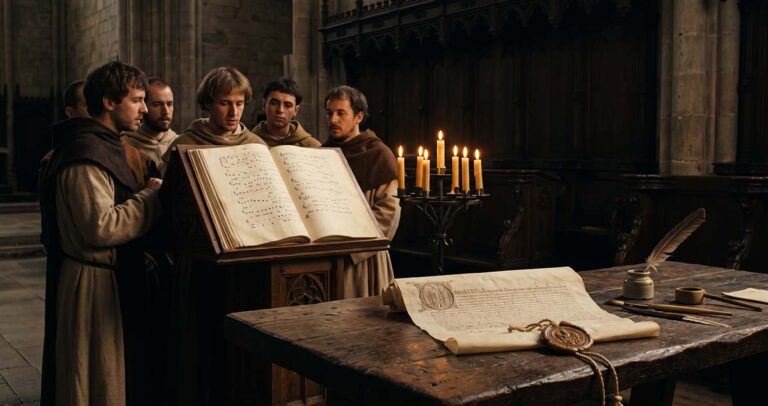
This is Episode 7 of Music and the Moral Panic, examining England’s theater closures from Parliament’s wartime suspension of stage plays in 1642 through the much harsher enforcement campaign of 1647 and 1648. Religious morality, wartime emergency, public order, and longstanding hostility to theater all mattered. The decisive turning point came in February 1648, when suppression reached beyond performances toward players, spectators, and the physical spaces that allowed audiences to gather. The historical record doesn’t prove that fear of class mixing or political discussion was Parliament’s single hidden motive. The escalation does reveal a broader institutional problem: the playhouse had become a place where a socially heterogeneous public could repeatedly assemble and respond together, and by 1648 the state was governing the audience as well as the stage.
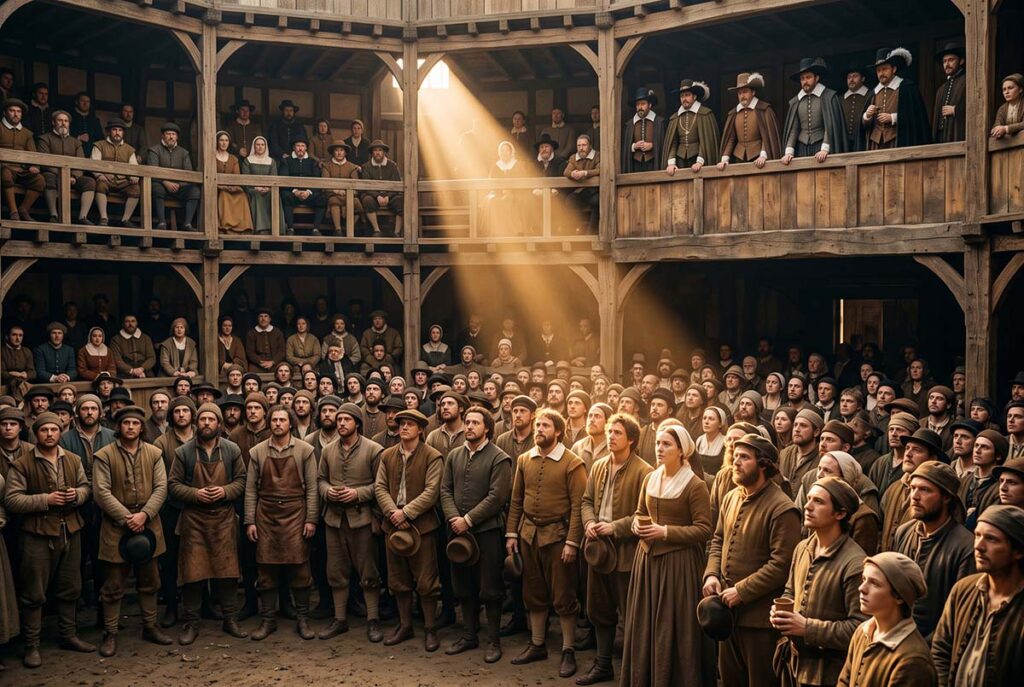
A London playhouse in the early seventeenth century made the social order visible before the actors said a word. Apprentices and laborers crowded the yard while merchants and gentlemen occupied more expensive places in the galleries. Admission prices preserved distinctions of wealth and rank, and nobody mistook a servant for a gentleman simply because both had entered the same building. Yet they were all watching the same performance at the same time.
That combination mattered. Public theater didn’t erase hierarchy, but it repeatedly brought people from sharply different positions into one commercial cultural space. A servant, a tradesman, and a prosperous patron might occupy different parts of the building while listening to the same words and reacting to the same event. For several hours, social separation remained visible while collective attention made those separate people an audience.
The playhouse had created a public without first making that public equal.
The Playhouse as Common Ground
The Fortune Theatre offered a revealing glimpse of the official unease surrounding these gatherings long before Parliament ordered the stages closed. In 1612, civic authorities acted against music associated with dancing after performances when the resulting crowds were blamed for disorder. The incident doesn’t establish that London theaters routinely produced riots, nor does it prove that government officials had already developed a coherent political theory of theatrical assembly. Its importance lies in the behavior authorities chose to regulate.
The formal performance had ended, but the audience hadn’t immediately dissolved. Music and dancing carried collective activity beyond the theatrical event and into the surrounding social space. People who had just shared the same performance remained together and began acting as a crowd. That transition, from spectatorship to collective behavior, placed the playhouse inside a larger problem of urban government.
Authorities had practical reasons to care about crowds. Early modern London was densely populated, politically volatile, and accustomed to regulating markets, streets, public celebration, religious observance, and other forms of communal life. A theater audience belonged to that same physical world. What made the playhouse unusual was its ability to manufacture such gatherings routinely, commercially, and at considerable scale.
The crowd was still stratified. The galleries preserved distinctions that the street and the law recognized. Yet the people inside were experiencing one cultural event together, and that shared attention gave the building a social function larger than entertainment.
When the Costume Proves the Point
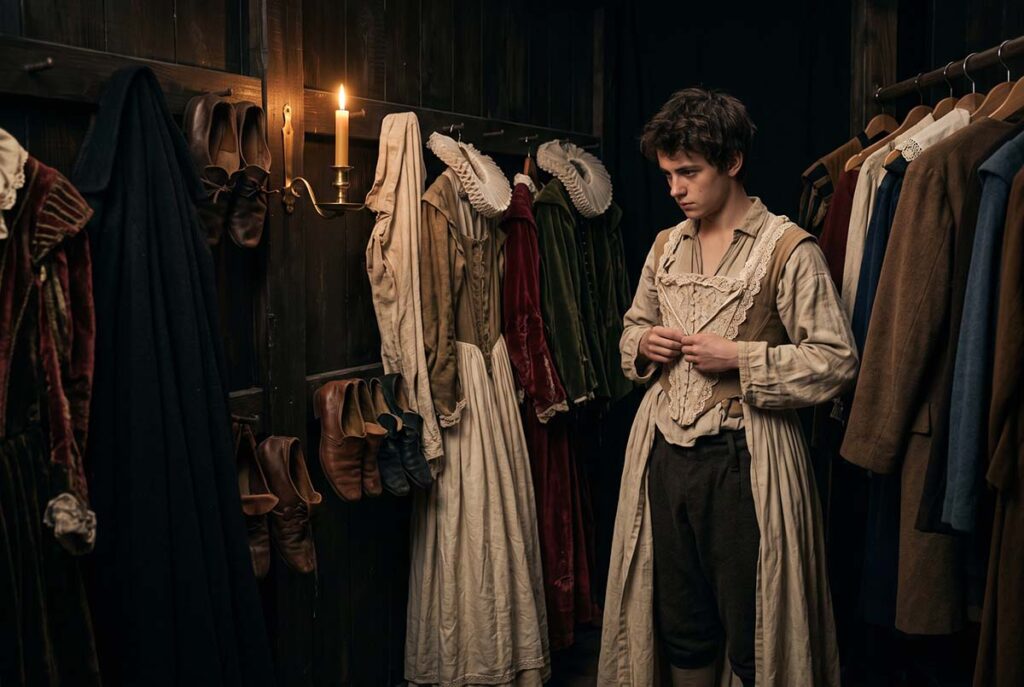
English society had spent generations trying to make status readable through appearance. Tudor sumptuary legislation regulated clothing and consumption according to rank, wealth, and social position, though the major English statutory regime had largely ended by around 1604. Similar forms of regulation continued elsewhere in early modern Europe. These laws also reflected concerns about luxury spending and imported goods, but they belonged to a culture in which clothing served as public information.
Fabric could announce rank before anyone spoke. Ornament, cut, expense, and material quality helped distinguish inherited position from ordinary labor. Clothing made hierarchy visible.
The commercial stage complicated that system every afternoon. Working actors could appear in the visual language of kings and noblemen, while professional female roles before the Restoration were ordinarily performed by boys or young men dressed to represent women. The point isn’t that theatrical costume abolished social categories. Everyone involved understood that a performer remained a performer when the play ended.
What the stage demonstrated was that the outward signs of identity could be manufactured. Rank could be represented through fabric and gesture. Gendered appearance could be constructed for an audience that knowingly participated in the illusion. A social order that depended partly on visible distinctions was confronted with an institution whose business consisted of reproducing those distinctions on demand.
The theater made hierarchy look less self-evident because it exposed some of the machinery behind recognition. A costume could make an audience accept a king who wasn’t a king. The social category remained powerful, but the stage showed how much that power depended on collective agreement.
That realization didn’t cause Parliament to close the theaters. The documentary record doesn’t support such a simple chain of motive. It does help explain why the playhouse belonged to a broader early modern world in which dress, status, representation, public behavior, and legitimate assembly were all matters that authority attempted to keep legible.
Warnings Without Force
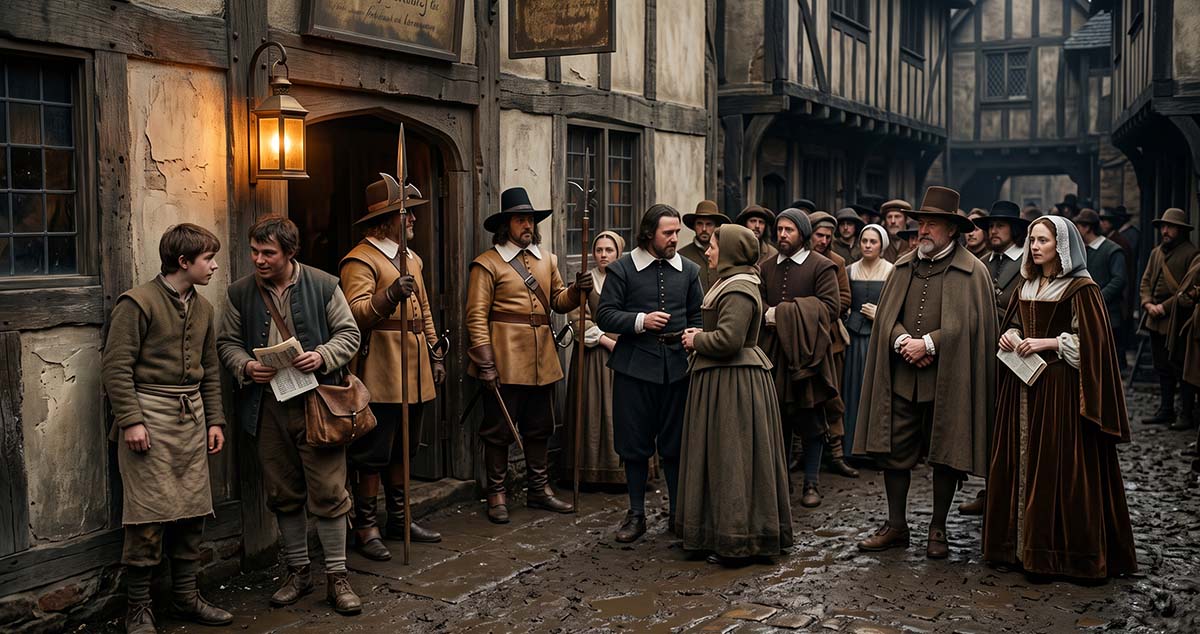
England entered civil war in 1642 amid conflicts over political authority, religion, constitutional power, and the relationship between Parliament and the Crown. On September 2, Parliament ordered public stage plays to cease. Later memory often compresses the next eighteen years into a permanent Puritan theater ban beginning on that date, but the original measure belonged to the immediate crisis of war.
Parliament described public theatrical entertainment as unsuitable during a period requiring solemnity and national humiliation. Religious and moral objections were genuine. Anti-theatrical criticism had long attacked perceived vice, frivolity, gender representation, and the moral character of performance. Wartime emergency intensified those arguments rather than replacing them.
The order therefore matters on its own terms. Parliament had reasons it openly stated, and those reasons shouldn’t be dismissed simply because later enforcement reveals more about the problem. The revealing part of the history begins with what happened next.
Theaters didn’t disappear merely because Parliament had spoken.
Performances continued, sometimes clandestinely, and audiences continued to appear. A rule that could close legitimate theatrical institutions on paper couldn’t automatically eliminate the appetite those institutions had satisfied. Every renewed performance turned a declaration of wartime morality into an enforcement problem.
You cannot stop a crowd with a sermon.
Continued theatrical activity forced Parliament to confront the practical consequences of suppression. The question was no longer whether public plays were appropriate. The state had to decide what it was prepared to do when performers kept performing and spectators kept arriving.
The State Tears Down the Walls
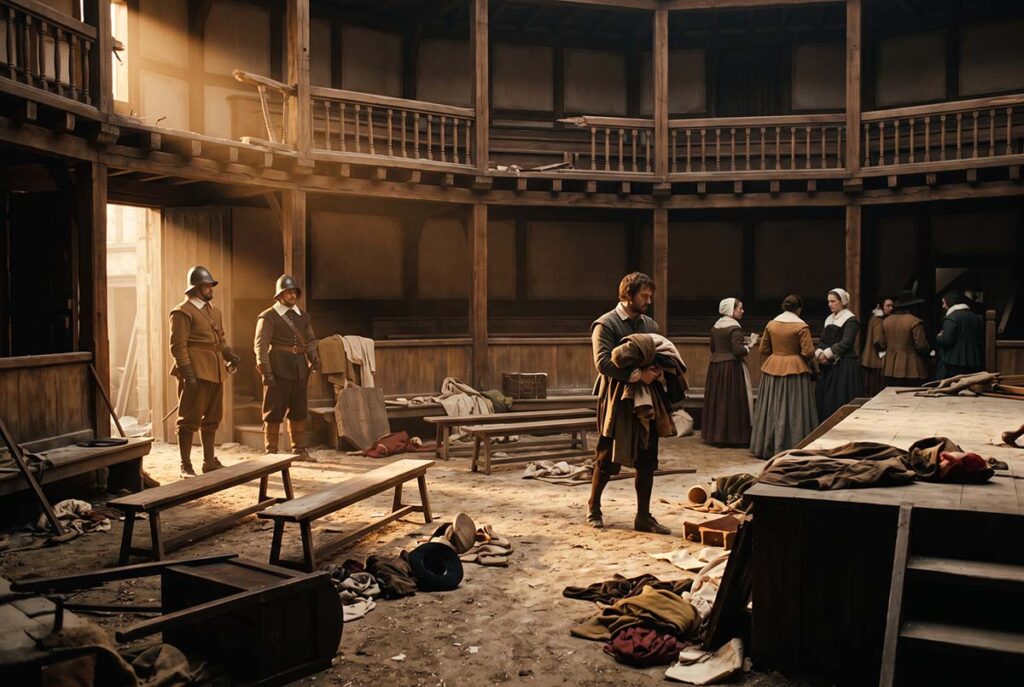
Parliament’s response hardened in 1647. Measures against theatrical activity became more coercive, and common players could face imprisonment. Then the February 1648 ordinance changed the scale of the campaign.
The new measure sought the utter suppression and abolishing of stage plays. Enforcement reached beyond the performance itself and into the infrastructure that allowed theater to exist. Authorities could intervene against the physical spaces associated with performances, and spectators themselves could face penalties.
That last detail changes the historical meaning of the crackdown.
A spectator didn’t write the play. A spectator didn’t organize the company, perform the role, or own the building. Yet attendance could now bring an ordinary audience member within the machinery of suppression. The state had widened its jurisdiction from the stage to the human system surrounding it.
Parliament criminalized the act of being present where other people had gathered.
The escalation deserves careful handling. It doesn’t prove that Parliament secretly invented religious objections while privately worrying only about class mixing or political discussion. Wartime emergency, moral criticism, religious seriousness, and public order remain part of the documented history. The stronger argument comes from watching what enforcement had to encompass once performances continued.
The play was no longer enough. The actor wasn’t enough. Suppression had to reach the spectator and the architecture that transformed individual spectators into an audience.
That architecture mattered because public theater participated in an early modern communications world broader than print. Sermons, rumor, marketplaces, ballads, processions, players, and other public forms allowed information and opinion to circulate through people who didn’t necessarily participate in elite literary culture. A playhouse could repeatedly gather a heterogeneous audience and let that audience react collectively.
No single performance had to be revolutionary for the institution to matter politically. The building’s significance came from its capacity to produce a public.
During a civil war, Parliament devoted coercive authority to preventing that machinery from operating. The historical record can’t tell us that every official involved understood the problem in those terms. The escalating reach of the law nevertheless shows what suppression ultimately required.
The state could condemn a play. To stop the theater, it had to govern the people around it.
Verdict: What They Were Actually Afraid Of
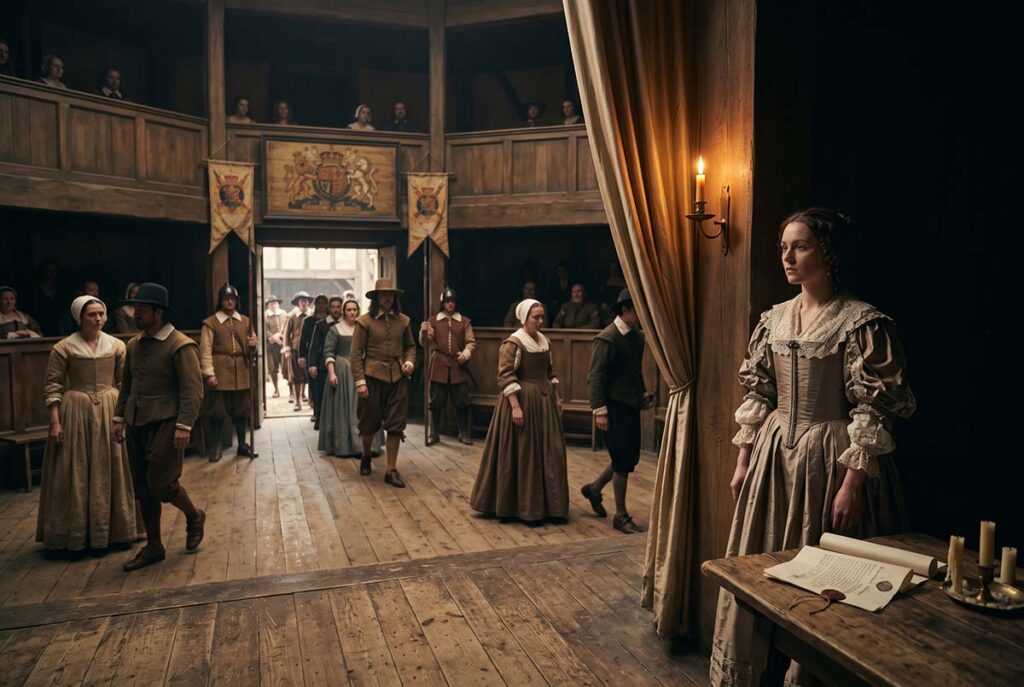
The Stuart monarchy returned in 1660, and professional theater returned with it. Yet reopening didn’t mean that the stage became an unrestricted civic commons. The restored theatrical system operated under royal authorization, with legitimate companies dependent on patents and institutional permission.
The Restoration also changed the visible world of the stage. Women began appearing professionally in female roles, replacing the earlier convention in which boys and young men had performed them. The theatrical institution changed substantially, but its relationship to political authority didn’t disappear.
Suppression ended. Supervision remained.
That reversal prevents an easy story in which freedom simply defeated censorship. Theaters returned because a new regime authorized their return. The stage had survived, but legitimacy still descended from institutional power.
Seen across the entire sequence, September 1642 is only the beginning of the story. The original wartime suspension tells us why Parliament said theatrical entertainment should stop. The years that followed show what Parliament eventually had to regulate when people refused to stop gathering.
By 1648, the state was reaching toward players, spectators, attendance, and the physical space that made collective spectatorship possible. The audience had entered the jurisdiction of suppression.
They shut down the buildings because they feared the crowd that had no reason to stay separate.
Episode 6 followed authority into Sunday recreation, Morris dancing, alehouses, and popular festivity, where unsupervised pleasure could create social networks beyond institutional control. Episode 7 carries that tension indoors, into a commercial building capable of turning strangers into an audience.
The next episode moves beyond the building. In colonial South Carolina, authority will confront a form of communication that can travel through a gathering and beyond it. The object under suspicion will be a drum.
Frequently Asked Questions
Why did Parliament close the English theaters in 1642?
Parliament ordered public stage plays suspended on September 2, 1642, as England entered civil war. The order treated theatrical entertainment as inappropriate during a period of national crisis, religious seriousness, and political humiliation. The initial measure was a wartime suspension. The more coercive enforcement campaign developed later in the decade.
What changed between the theater closures of 1642 and the suppression campaign of 1648?
Enforcement expanded dramatically. The 1642 order instructed stage plays to cease, but theatrical activity continued. By 1647 and especially February 1648, Parliament had moved toward harsher measures against players, spectators, and theatrical infrastructure. The state’s reach now included the social machinery that allowed performances and audiences to continue.
What were sumptuary laws, and why do they matter to this story?
Sumptuary laws regulated clothing and consumption according to social rank, wealth, and status. In England, the major statutory regime largely ended around 1604, although related regulation survived elsewhere in early modern Europe. They matter here because theatrical costume demonstrated how the visible signs used to identify rank and social position could be reproduced.
What happened at the Fortune Theatre in 1612?
In 1612, civic authorities acted against music associated with dancing after performances at the Fortune Theatre when crowd behavior was blamed for disorder. The incident doesn’t prove that playhouses routinely produced unrest. It does show that authorities were already responding to the way theatrical entertainment could spill into collective behavior beyond the formal performance.
Did public theaters erase class distinctions in seventeenth-century London?
No. Admission prices and seating arrangements preserved clear economic and social differences inside the playhouse. Apprentices, servants, tradespeople, merchants, and gentlemen remained socially distinct. What mattered was that people from markedly different positions could occupy the same building, experience the same performance, and respond simultaneously as an audience.
What does this episode actually establish about Parliament’s fear of assembly?
The historical record doesn’t prove that Parliament suppressed theater primarily to prevent class mixing or political discussion. The stronger argument comes from the pattern of escalation. Once performances and audiences continued, enforcement expanded toward bodies, buildings, and attendance itself. Theatrical assembly had become part of the problem the state believed it needed to govern.
Why does the English theater crackdown matter beyond theater history?
The playhouse belonged to a larger early modern communications environment that included sermons, rumor, marketplaces, ballads, processions, and public performance. Its significance came partly from its capacity to turn separate spectators into a responsive public. The episode shows how cultural regulation can expand from judging expression toward governing the spaces and gatherings through which people communicate collectively.
Why would colonial governments later treat drums as a political threat?
The next episode follows the institutional problem into colonial South Carolina, where communication no longer depends on a playhouse or printed page. After the Stono Rebellion, the Negro Act of 1740 restricted drum use among enslaved Africans. The historical question becomes what happens when collective communication can travel across distance and support organized action.