Episode 9: The Album Takes Command (1965–1967)
This is Episode 9 of Vin Amorando’s History of Rock documentary series, examining how the album revolution of 1965 to 1967 expanded rock beyond the commercial and physical assumptions of the seven-inch single. Brian Wilson used the studio as part of composition, Bob Dylan exploited the LP’s greater duration, and the Beatles with George Martin made recording technology part of the musical object through Revolver and Sgt. Pepper’s Lonely Hearts Club Band. The Turning Point came when Sgt. Pepper’s arrived in 1967 as an album designed to function as a complete object instead of a package from which singles were extracted. That creative expansion was genuine, and its larger scale simultaneously gave the recording industry a larger unit of attention, prestige, investment, and purchase to finance, market, and control.
By the middle of the 1960s, pop music moved through an industrial system built around turnover. Jukebox operators needed new records, radio schedules favored compact songs that fitted predictable programming clocks, and promotion depended on a continuing supply of releases that could be played repeatedly and sold as individual hits. For much of rock and roll, the seven-inch 45 rpm single had become more than a format. It was part of the physical environment in which the music was expected to function.
That environment had existed alongside another one for years. Columbia introduced the commercial long-playing record in 1948, and RCA introduced the 45 the following year. Both formats survived, but they developed different associations. LPs were well suited to classical works, cast recordings, jazz, and longer programs, while the inexpensive 45 became deeply entwined with teenage pop, jukeboxes, radio promotion, and the emerging rock and roll market.
Physical formats carry assumptions about the work they contain. A seven-inch record rewards compression because the commercial system surrounding it rewards compression. Radio rotation, manufacturing, distribution, jukebox turnover, and individual song sales all encouraged musicians and producers to think within relatively tight boundaries.
By 1965, several of rock’s most ambitious artists had begun pushing those boundaries from different directions. Their arrangements were growing denser, recording technology was entering the composition itself, and some songs were becoming too long or too internally complex to behave like conventional pop singles. The old format could still contain remarkable music. The more consequential development was that musicians had begun discovering what became possible when they stopped treating its limits as natural law.
The Seven-Inch Ceiling
The 45 didn’t impose one rigid duration on every record, but it belonged to a commercial culture organized around short, repeatable songs. That culture had been extraordinarily productive. Rock and roll itself had flourished within it, and some of the most durable recordings in popular music history were built for precisely that economy.
The pressure toward compression nevertheless shaped decisions before a listener heard a note. A song had to occupy physical groove space. A radio station had schedules to maintain. A jukebox operator wanted turnover. A record company wanted another release capable of becoming another hit. The format, the institutions distributing it, and the habits of the audience reinforced one another.
The LP offered a different amount of physical and temporal room. By the middle of the 1960s, that room was becoming artistically significant because musicians had begun asking the recording to do things that required sustained space. The important change wasn’t the invention of long-playing records. They’d already existed for nearly two decades. What changed was the growing conviction among rock musicians that the additional space belonged to them.
When Wilson Left the Road

Brian Wilson’s route into that space began with exhaustion. After the pressures of touring became increasingly difficult to sustain, he withdrew from regular Beach Boys touring after 1964 and devoted more of his attention to recording. The separation between the road and the studio gave him something unusually valuable for a pop musician: the freedom to construct records without assuming that the resulting arrangements had to be reproduced by the touring group every night.
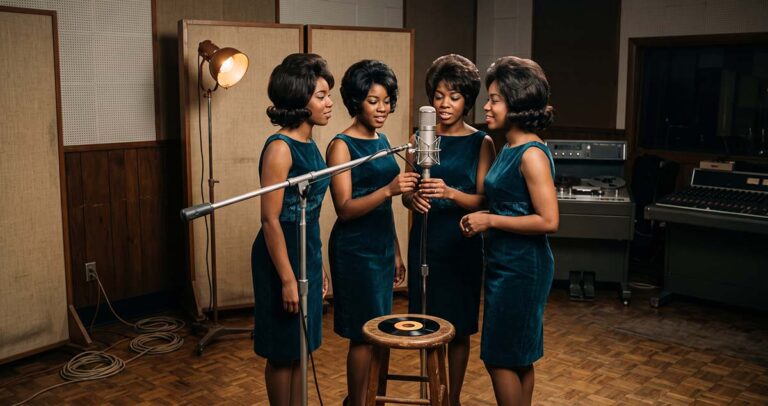
Wilson used the distinction aggressively. Recording became part of composition rather than simply the preservation of a performance. Musicians could be selected for the needs of a particular arrangement, unusual combinations of instruments could be layered together, and a track could develop through repeated decisions made inside the studio.
The Pet Sounds sessions made the possibilities especially clear. Wilson worked with elite Los Angeles session players capable of moving between instruments, textures, and complicated arrangements with remarkable efficiency. Conventional rhythm-section sounds shared space with orchestral instruments, unusual percussion, keyboards, bass harmonica, bicycle bells, and other colors that expanded the vocabulary available to a pop record.
The record’s coherence doesn’t require the mythology that Pet Sounds was conceived from its first moment as a rigidly planned concept album. Its significance survives without that claim. Arrangement, songwriting, sequencing, session performance, and recording technique created an emotional and sonic continuity that made the LP feel more substantial than a container assembled around a few prospective hits.
The studio could now create musical objects whose identity depended upon the recording process itself. Once that happened, the old expectation that a record should document something a touring band could simply reproduce became less important. The recording acquired its own logic.
Across an LP, that logic had room to accumulate. Sounds could answer one another across tracks, sequence could become meaningful, and an atmosphere could survive longer than one side of a single. Twelve-inch vinyl hadn’t suddenly become new technology. Musicians had begun treating its extra space as creative territory.
Dylan and the Demand for Space
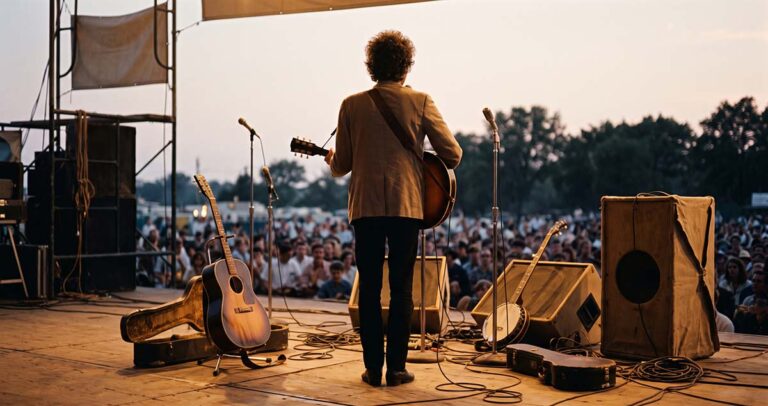
Bob Dylan reached the same territory by another route. His principal pressure came from language, duration, and form. Highway 61 Revisited and Blonde on Blonde gave him room for songs whose density and length pushed beyond the conventions surrounding the pop single.
That distinction matters because no single invention or musician explains the album’s rise. Wilson needed space for arrangement and sonic architecture. Dylan used the LP’s duration to let songs unfold at lengths that radio-oriented pop rarely encouraged. Their methods were radically different, yet both placed greater artistic value on the larger container.
“Desolation Row,” closing Highway 61 Revisited, runs for roughly eleven minutes. On Blonde on Blonde, “Sad Eyed Lady of the Lowlands” occupies an entire album side. Dylan wasn’t proving that every serious song needed to be long. He was demonstrating that length itself no longer needed to apologize for failing the assumptions of the single economy.
The LP could accommodate excess as part of the proposition. A songwriter could follow an image, argument, narrative, or accumulation of language beyond the point where a radio programmer would normally begin looking at the clock. Duration became something an artist could use rather than merely something an institution had to tolerate.
At almost the same moment, the Beatles were expanding album scale through technology. By Revolver, tape manipulation, treated vocals, unconventional microphone techniques, altered timbres, and Indian instrumentation had entered the substance of the recordings. The studio wasn’t simply making the band sound better. It was producing sounds whose existence depended upon the recording process.
“Tomorrow Never Knows” made the break especially clear. Its identity belongs to its construction on tape. Remove the manipulation and processing, and the composition as listeners know it changes with them. Recording technology had moved from delivery system to compositional material.
These were different revolutions converging on one object. Wilson used the LP to build sonic architecture. Dylan used it to stretch language and duration. The Beatles increasingly used it as a place where studio construction could produce music that no conventional four-piece stage performance could fully explain.
The Object You Could Not Skip
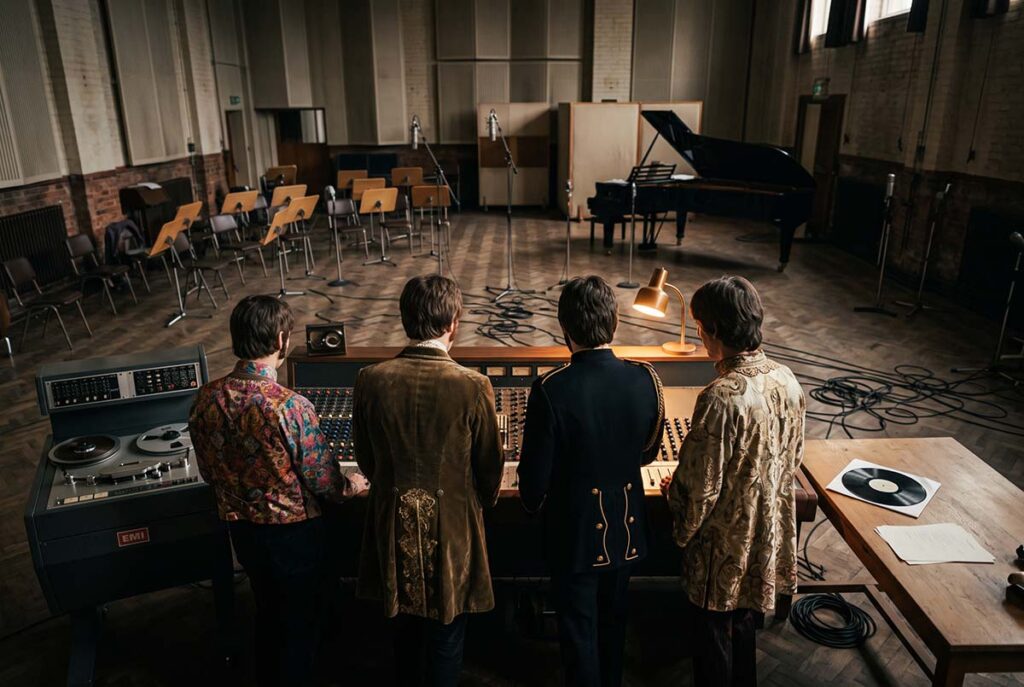
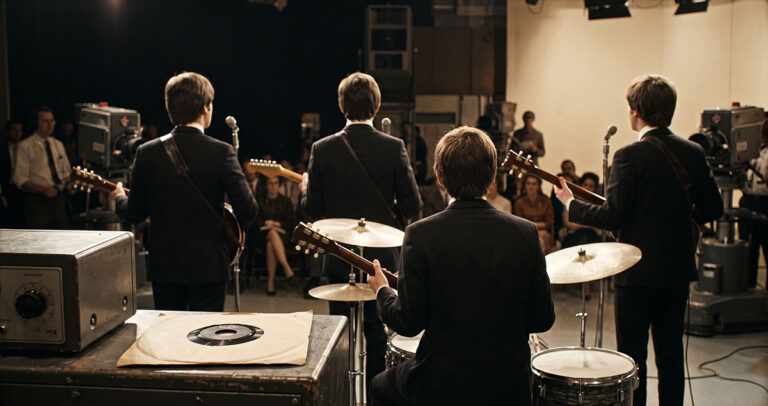
The Beatles stopped touring in 1966, removing one of the last practical reasons their records had to remain answerable to the stage. George Martin and the group could now work with orchestration, tape, editing, overdubbing, arrangement, and studio technique without asking how four musicians would reproduce the result before an audience.
The sessions for Sgt. Pepper’s Lonely Hearts Club Band stretched from late 1966 into 1967 and consumed more than 400 studio hours. That investment says something larger than “the Beatles worked hard.” Studio occupation itself had become part of the artistic proposition. An important rock record could justify sustained construction because the finished recording was now being valued as an object in its own right.
The original album sharpened that proposition through its release strategy. No song was lifted from the original UK or US album as a single. The presentation encouraged continuous listening, and the sequence carried an authority that distinguished the record from a package built primarily to surround whichever track became a hit.
Sgt. Pepper’s wasn’t the first great rock album. It was the first rock album you were not permitted to skip.
The line captures something about the relationship between prestige and consumption. A single asks for attention one song at a time. An album presented as a coherent whole asks for a larger block of the listener’s time and for the purchase of the larger object containing it. Artistic integrity and commercial scale could now reinforce one another.
The 45 remained commercially powerful. The Beatles themselves continued making major singles, including during the period when Sgt. Pepper’s was taking shape. What accelerated wasn’t the disappearance of one format but the hierarchy surrounding the other.
Serious rock identity increasingly came to be judged at album length. Musicians could make statements across a side or an entire LP. Critics could evaluate records as bodies of work. Listeners could learn an artist through a sequence rather than through whichever song radio selected. The physical dimensions of vinyl were becoming part of rock’s hierarchy of seriousness.
That was the Turning Point. Album-scale artistic ambition had accumulated enough prestige that the commercial value of the complete object became impossible to ignore.
What Liberation Costs
Artistic prestige, once established, becomes a budget line. The album’s growing status gave record companies a rationale for financing work at the same scale musicians were beginning to imagine it. More complicated recordings could require more sessions, more studio hours, more specialized labor, and greater investment.
None of that made the creative expansion fraudulent. Wilson’s studio work was genuine. Dylan’s use of duration was genuine. The Beatles’ transformation of recording technology into musical material was genuine. Commercial usefulness didn’t erase any of it.
The industry’s great advantage was that it didn’t need to defeat the album revolution. It could fund it.
That response mattered more than a later story in which corporations arrive after the creative act and corrupt something that had previously been pure. Institutions could build themselves around the new freedom while the freedom was still being established. Album-oriented careers, recording budgets, artist development, promotion, radio formats, and touring systems would eventually grow together as parts of a much larger structure. The LP was only one enabling force among several, but its prestige gave that structure a powerful organizing unit.
For decades, musicians would imagine careers through albums while the record business learned to organize investment around exactly the same object. Listeners treated records as statements. Critics ranked albums. Artists measured periods of their creative lives by releases. Labels could market, finance, contract, and recoup around the unit musicians increasingly regarded as the natural scale of serious expression.
The irony sits inside the achievement. Musicians proved that audiences wanted sustained worlds, longer writing, elaborate production, and records whose meaning accumulated across a side or an entire LP. That appetite gave artists permission to expand, and it gave the industry evidence that expansion had a market.
The creative liberation won by Wilson, Dylan, the Beatles, George Martin, and others supplied rock with a larger canvas. It also supplied the recording business with a larger unit to finance and sell.
Verdict
The previous chapter ended at Newport in 1965, where Dylan’s electric performance fractured the folk world over authenticity, ownership, and what musicians were permitted to become. Episode 9 moves the argument from the meaning of the music to the physical and commercial object carrying it. Once rock’s ambitions grew beyond the dimensions of the single, the industry’s relationship to ambition changed with them.
Wilson withdrew from regular touring and treated the studio as part of composition. Dylan allowed songs to occupy the space their language demanded. The Beatles abandoned the requirement that increasingly elaborate recordings make straightforward physical sense onstage. Those achievements remain what they were: genuine creative expansions of popular music.
The recording business recognized something inside those achievements. Album scale could carry attention, prestige, investment, and purchase together. The same object that allowed musicians to think larger allowed institutions to build larger systems around the result.
That recognition leads directly into the next chapter. Berry Gordy’s Motown will show a different kind of institutional intelligence through disciplined hit production, vertical integration, crossover strategy, and extraordinary musicians whose labor could remain hidden behind the product. Stax will develop another model inside a converted theater, where an integrated working band makes records within a segregated society.
The machinery changes. The question underneath it doesn’t.
The artists proved audiences would pay for ambition at scale. The industry simply learned to set the price.
Frequently Asked Questions
What did the album revolution of 1965 to 1967 actually establish?
It established the LP as a larger container for rock ambition rather than simply a longer package for individual songs. Brian Wilson expanded arrangement and studio construction, Bob Dylan expanded duration and language, and the Beatles expanded recording technique. Their different approaches converged on the idea that the album itself could carry the primary artistic statement.
Why was the seven-inch single so important to early rock music?
The seven-inch 45 fitted an industrial system built around radio rotation, jukebox turnover, compact songs, frequent releases, and individual hits. Ambitious music thrived within that system, but the system rewarded compression. By the mid-1960s, elaborate arrangements, longer writing, and studio experimentation were pressing against those practical boundaries.
How did Brian Wilson and Pet Sounds change the role of the recording studio?
After withdrawing from regular Beach Boys touring, Brian Wilson gained greater freedom to construct recordings without requiring a touring band to reproduce every arrangement onstage. Pet Sounds used session musicians, unusual instrumentation, arrangement, and recording technique so extensively that construction inside the studio became inseparable from the music itself.
What did Revolver and Sgt. Pepper’s change about Beatles records?
Revolver pushed tape manipulation, treated vocals, unconventional microphone techniques, and other studio processes into the substance of the music. After the Beatles stopped touring, Sgt. Pepper’s pushed that freedom further because the recording no longer had to function as something four musicians could reproduce onstage. The album could develop according to the internal possibilities of the studio.
Why are Highway 61 Revisited and Blonde on Blonde important to album history?
Bob Dylan reached album scale through language and duration rather than primarily through elaborate studio construction. Highway 61 Revisited and Blonde on Blonde gave extended songs enough physical and temporal room to resist the normal compression surrounding the pop single. His work showed how the LP could accommodate length and formal excess as part of the artistic proposition.
Did Sgt. Pepper’s replace the single and make the album dominant overnight?
No. Singles remained commercially important in 1967, including for the Beatles themselves. The decisive acceleration involved prestige. Sgt. Pepper’s crystallized the idea that a rock album could demand attention as a complete, ordered object, making album-scale ambition increasingly central to how serious rock identity was judged.
What is the episode’s verdict on artistic freedom and the music industry?
The musicians’ creative expansion simultaneously demonstrated the commercial value of album scale. Audiences showed that they would devote time and money to sustained worlds, longer writing, elaborate production, and records whose meaning accumulated across an LP. Labels could organize larger investments, promotion, contracts, and careers around that same demand.
How do Motown and Stax continue this argument in Episode 10?
Episode 10 moves from the expanding album to two different institutional systems. Berry Gordy’s Motown uses vertical integration and disciplined hit production while musicians such as James Jamerson often remain hidden behind the finished product. Stax develops another model inside an integrated working environment, carrying forward the question of who builds and controls the machinery surrounding music.