Episode 8: When Folk Plugged In (1948–1967)
This is Episode 8 of Vin Amorando’s History of Rock documentary series, examining how the Newport Folk Festival became the public breaking point in a much older struggle over who possessed the authority to define political folk music. Pete Seeger, the Weavers, Joan Baez, and Phil Ochs inherited an acoustic culture whose suspicion of commercial institutions had been earned through blacklisting, political surveillance, and participation in labor and civil rights movements. Bob Dylan increasingly rejected the expectation that political authenticity required one sanctioned musical language. His electric performance at Newport on July 25, 1965 became the turning point because competing definitions of authenticity could no longer coexist quietly. Folk’s survival doctrine had hardened into a claim of cultural ownership, and folk rock fractured that authority while carrying much of the movement’s literary and political seriousness into a wider commercial culture.
The Engine They Built
In the late 1940s, the basement clubs and union halls of Greenwich Village belonged to something more deliberate than a music scene. Woody Guthrie, Pete Seeger, the Almanac Singers, and the organizers around People’s Songs treated music as working infrastructure. An acoustic guitar could travel through a meeting hall or a picket line with almost no machinery around it. A song could carry memory, solidarity, and political argument wherever people were willing to sing it.
That portability gave folk unusual power. Songs could be learned instead of purchased, altered instead of preserved, and passed between communities without requiring the commercial entertainment business to approve the transaction. The distance between performer and audience remained small because participation was built into the form. Folk’s politics didn’t merely reside in lyrics. They existed in the way the music moved.
Yet political seriousness didn’t keep the revival outside the marketplace. By 1950, the Weavers had turned material rooted in folk, labor, and left-wing traditions into major commercial success. The movement had accomplished something remarkable: dissent had become a hit.
Success also exposed a vulnerability. Folk had entered the same commercial system it distrusted, and its wider reach now depended partly on institutions capable of withdrawing access as readily as they granted it. The contradiction wouldn’t fully erupt for another fifteen years, but its machinery was already running.
The State’s Response
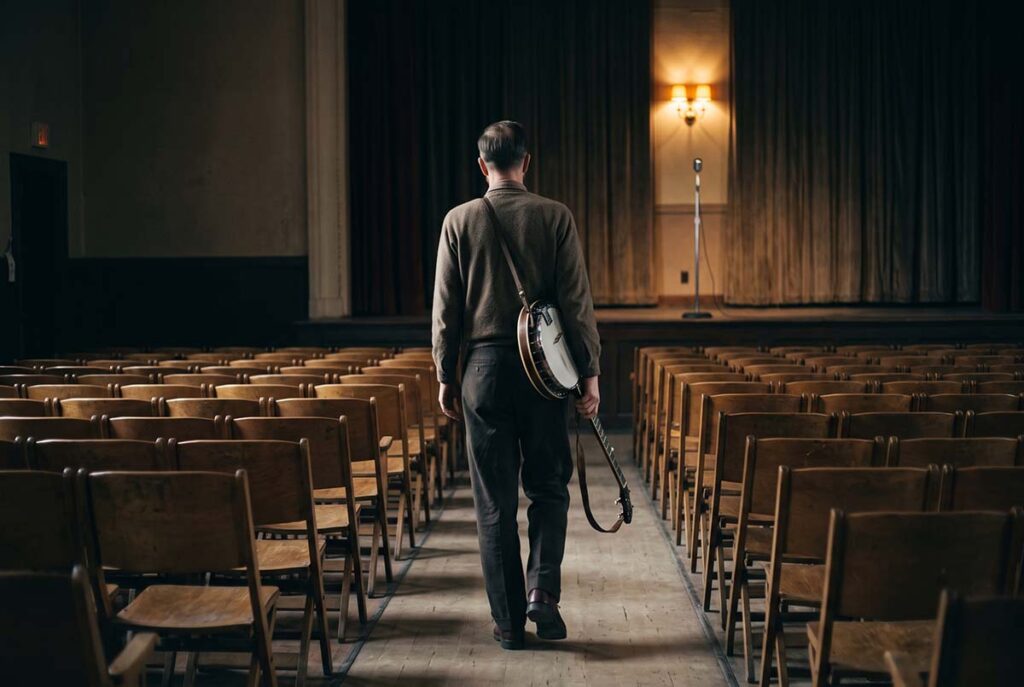
Pete Seeger and the Weavers learned what that dependency could cost during the anti-Communist campaign of the 1950s. Politically associated musicians became conspicuous casualties of a much broader effort against figures connected to labor politics and the American left. Seeger appeared before the House Un-American Activities Committee in 1955, while the Weavers lost much of the commercial infrastructure that had helped make them successful.
The damage wasn’t theoretical. Television exposure disappeared, major venues became harder to reach, and record-industry access narrowed. A culture that had briefly demonstrated its ability to function inside mass entertainment was pushed back toward smaller rooms and alternative networks.
That experience changed the meaning of acoustic music. A preference for simple instrumentation acquired moral weight because the commercial institutions surrounding popular culture had shown themselves capable of participating in political exclusion. The acoustic guitar became the movement’s credential, the one instrument the state had not yet figured out how to silence.
The credential had been earned. Musicians who’d watched careers disappear had good reason to value forms of legitimacy that commercial gatekeepers couldn’t grant or revoke. Acoustic folk connected the revival to inherited tradition while preserving an infrastructure that could survive without television executives, major venues, or friendly record companies.
The doctrine worked. Political folk survived the 1950s and entered the civil rights movement with extraordinary force. At places such as Highlander Folk School, musical traditions associated with labor organizing moved into another struggle, while Joan Baez carried folk onto one of the most visible political stages in the country at the 1963 March on Washington.
By the early 1960s, acoustic folk had survived persecution and returned to national political life with renewed authority. The same history that made its doctrine defensible, however, was beginning to turn that doctrine into a boundary.
The Cost of the Mission
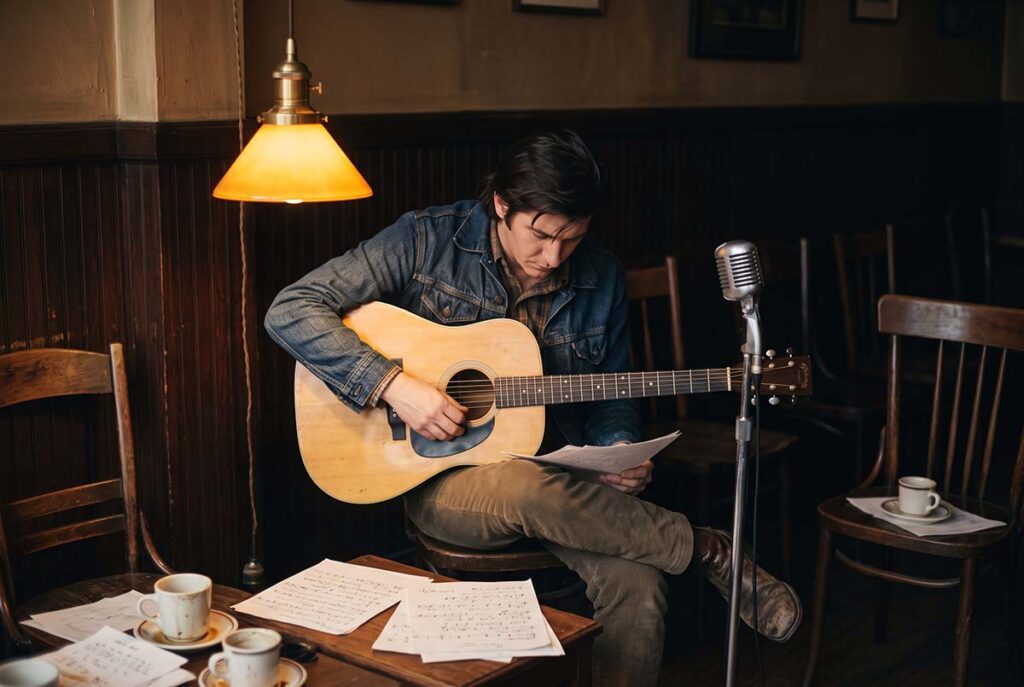
Phil Ochs embraced the folk singer’s political obligation with unusual intensity. He described himself as a singing journalist, and the description suited a body of work attached closely to war, racism, executions, political violence, and current events. His songs often behaved less like generalized statements of conscience than reports from an unfolding political emergency.
That specificity gave Ochs clarity, but it also kept his work tied tightly to the public record. The topical songwriter had to remain available to whatever injustice arrived next. Retreat into private experience or ambiguity could look like dereliction when a movement believed a singer had obligations beyond himself.
Federal authorities noticed Ochs. The FBI accumulated extensive material concerning a songwriter whose principal public weapon remained an acoustic guitar. The scale of that attention turns an abstract argument about political music into something much more tangible. Four hundred pages means the acoustic guitar was working exactly as intended.
Ochs’s later deterioration can’t responsibly be reduced to politics. Political disappointment, commercial decline, heavy drinking, and serious psychological distress intersected without producing one clean historical explanation. The narrower comparison matters more: Ochs remained committed to an outward-facing model of songwriting in which the artist continually returned to the week’s political emergency.
That was one answer to what a folk singer owed the movement. Bob Dylan was already developing another.
The Man Who Broke Rank
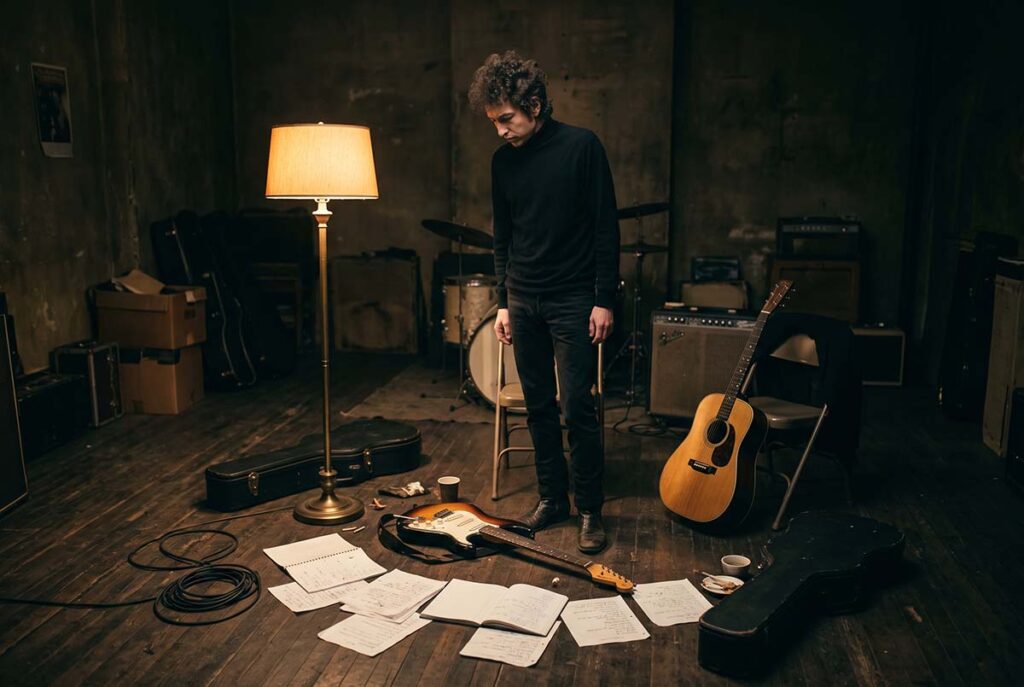
Dylan’s transformation began before Newport. His writing had already moved away from straightforward topical protest toward work that was more surreal, literary, ambiguous, and personally elusive. By the summer of 1965, the transition had appeared on record before it became a public confrontation on a festival stage.
For a movement accustomed to measuring political authenticity through collective purpose, the change presented a serious problem. Dylan’s songs were becoming harder to assign to a particular cause or immediate political use. The artist who’d been treated as one of folk’s most important public voices resisted the idea that his value depended on continuing to speak in the movement’s preferred register.
Less programmatic writing didn’t require political emptiness. Alienation, accusation, private experience, and surreal imagery could carry meanings that a literal topical song couldn’t. Dylan’s departure was therefore more difficult than simple abandonment. He was refusing to let the movement dictate the only legitimate terms of the argument.
By then, folk possessed enough infrastructure to enforce expectations without possessing any formal authority. Festivals, clubs, publications, labels, critics, organizers, and audiences could collectively decide what counted as serious, authentic, or politically useful. A culture shaped partly by resistance to commercial gatekeepers had acquired gates of its own.
Newport made them visible.
The Civil War at Newport
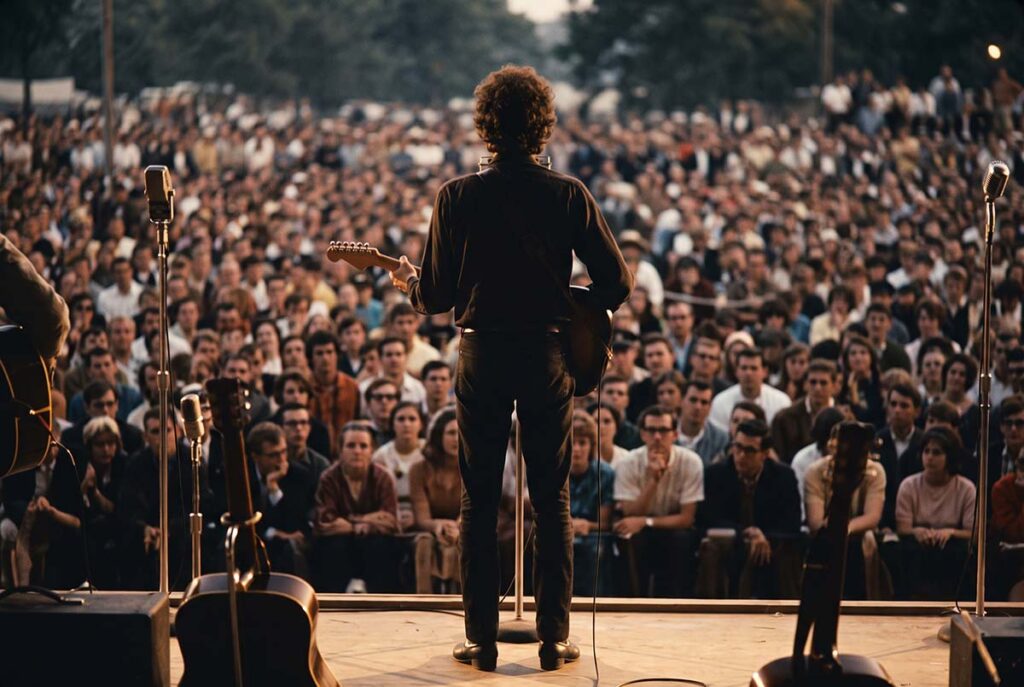
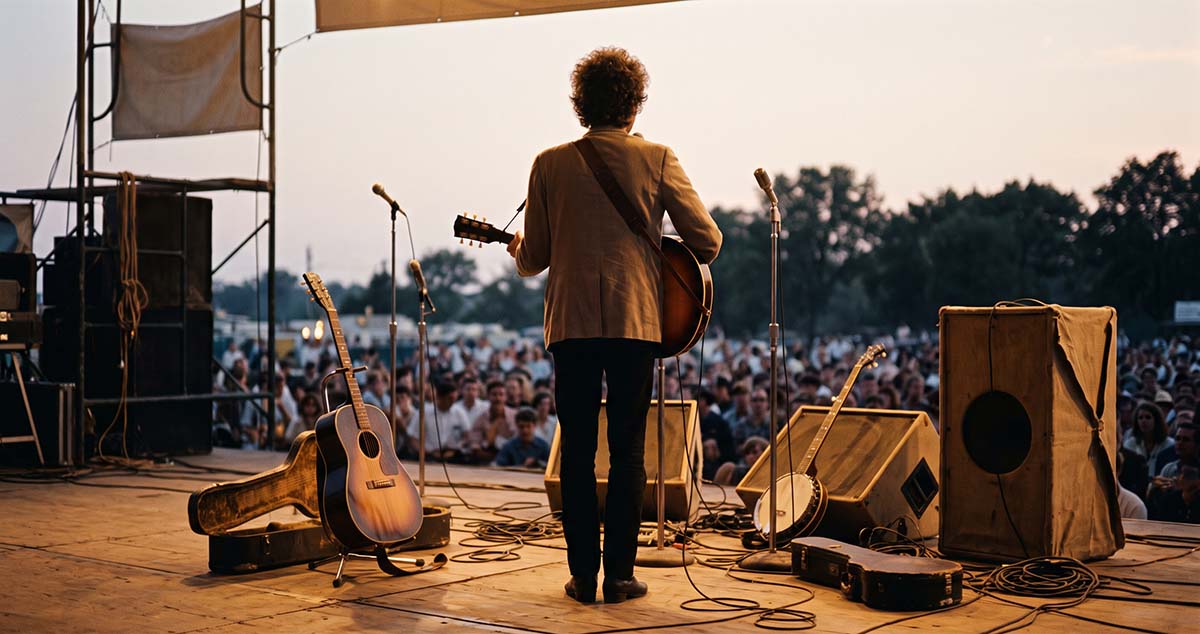
On July 25, 1965, Bob Dylan walked onto the stage at the Newport Folk Festival carrying an electric guitar. Electricity already carried cultural meaning before the band played. Within the revival’s symbolic world, amplification pointed toward rock and roll, mass commerce, and an entertainment business that folk had spent years learning to distrust.
The event quickly hardened into one of popular music’s most durable myths. Dylan plugged in, folk purists booed, and rock defeated folk. The story survives because it distributes the roles beautifully. Dylan becomes the fearless individualist, while the folk establishment becomes an aging collection of frightened traditionalists.
The historical record won’t cooperate. Hostility was real, but witnesses have disagreed about precisely what caused it. Poor sound, the short electric set, frustration with the performance circumstances, audience expectations, and genuine ideological anger all belong to the record. Treating every boo as a vote against electricity creates a cleaner story than the evidence permits.
Yet the controversy lasted because something larger than a sound problem had been exposed. Folk had spent years linking acoustic performance with sincerity, historical continuity, political usefulness, and resistance to commercial compromise. Dylan entered that world carrying an instrument associated with a different system of values. He crossed a boundary whose defenders believed history had given them good reason to maintain it.
Some of the anger was therefore about authority. Folk had survived political persecution partly by defining the terms under which its authenticity could remain independent of hostile institutions. Dylan took a language claimed by that culture and demonstrated that its future would no longer be determined exclusively inside those terms.
Newport didn’t settle a technical question about guitars. It exposed a struggle over who possessed the authority to define the sound of dissent. The folk establishment’s historical claim was legitimate, but legitimacy couldn’t confer permanent custody over what the form was allowed to become.
What Electricity Carried
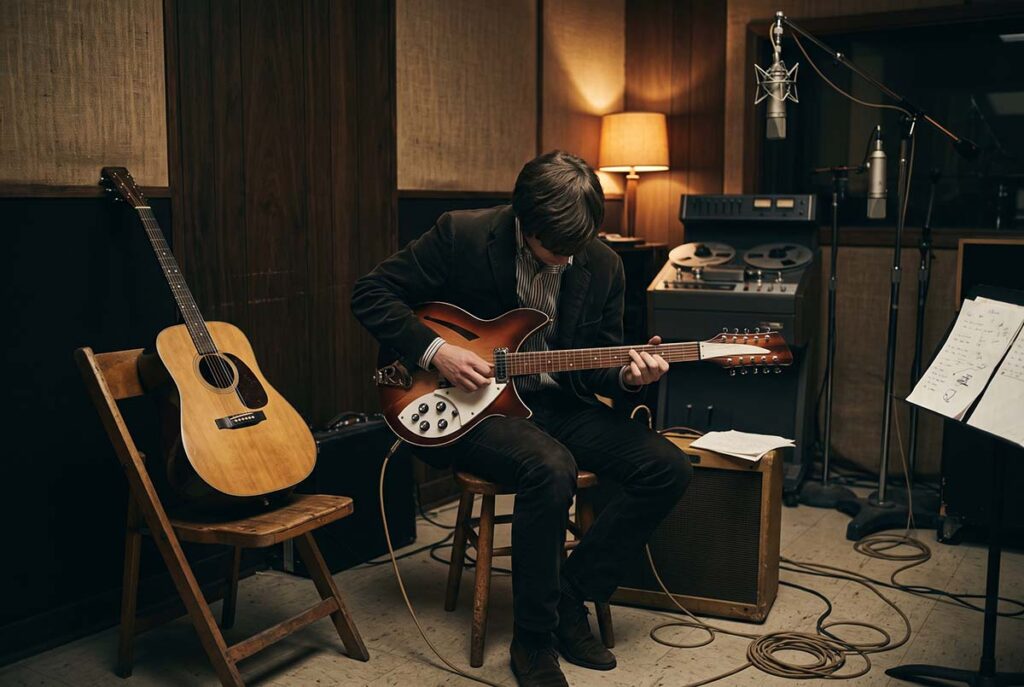
The commercial consequences were already visible in 1965. The Byrds’ electric treatment of Dylan’s “Mr. Tambourine Man” became a major hit, proving that writing associated with the folk world could operate inside the machinery of pop and rock. Drums, electric guitars, and the ringing sound of a twelve-string didn’t erase folk’s literary inheritance. They changed the infrastructure carrying it.
Simon and Garfunkel, Buffalo Springfield, the Byrds, and the wider folk rock movement extended that synthesis. Elements of folk’s lyrical seriousness and political awareness entered commercial music on a scale the blacklisted revivalists of the previous decade hadn’t possessed. The same mass culture that folk had learned to distrust became one of the systems through which its language escaped the original movement’s boundaries.
The purists weren’t foolish to be suspicious. Commercial institutions had already demonstrated their willingness to participate in exclusion, and commerce could certainly flatten political meaning into product. Their error was converting the circumstances of survival into a permanent definition of authenticity.
That is the period’s harder contradiction. Acoustic discipline helped preserve a political culture when mainstream institutions became hostile. Once that discipline hardened into ideology, it threatened to restrict the culture’s ability to change. Refusing commercial power could protect a message, but it could also limit how far that message traveled.
The blacklist could destroy a record contract and a television appearance. It could not destroy a number-one single.
Folk didn’t disappear when Dylan plugged in. Its exclusive authority fractured, and much of its seriousness migrated into rock, where new audiences, technologies, and commercial institutions would transform it again. By 1965, another transfer of authority was already beginning. Dylan, Brian Wilson, George Martin, and The Beatles were among the artists pushing beyond the single toward the album as a larger field of artistic ambition. Episode 9 follows that argument into the recording studio.
The folk establishment feared that electricity would corrupt the message. Electricity helped the message survive.
When a culture starts policing the sound of authenticity, someone outside the gate will carry its meaning farther, and the culture will never forgive them for it.
Frequently Asked Questions
What actually happened when Bob Dylan went electric at the Newport Folk Festival?
On July 25, 1965, Dylan performed at Newport with an electric band and encountered documented hostility. Eyewitness accounts don’t support one settled explanation for the reaction. Poor sound, the short set, audience expectations, performance circumstances, and ideological anger all appear in the historical record.
Why did acoustic music carry such political importance in the folk revival?
Acoustic folk survived a period when politically associated musicians lost television exposure, major bookings, and record-industry access during the anti-Communist blacklist. That experience gave acoustic instrumentation meaning beyond musical preference. It became a symbol of continuity and independence from commercial institutions capable of granting or withdrawing access.
What happened to Pete Seeger and the Weavers during the blacklist?
Pete Seeger and the Weavers became conspicuous casualties of the broader anti-Communist campaign against politically associated artists. Seeger appeared before the House Un-American Activities Committee in 1955, while the Weavers lost much of the commercial infrastructure that had supported their success. Political folk was pushed toward smaller venues and alternative networks.
What role did Joan Baez play in political folk music?
Joan Baez helped carry the folk revival’s political credibility directly into the civil rights movement. Her performance at the 1963 March on Washington placed acoustic folk on one of the most visible political stages in American history and showed that the tradition had survived the blacklist to reenter national political life.
Why is Phil Ochs described as a “singing journalist”?
Phil Ochs approached topical songwriting with unusual specificity, addressing war, racism, executions, political violence, and current events almost as reporting. Federal authorities accumulated extensive material concerning him. His later decline can’t responsibly be reduced to politics alone, but his career illustrates the demanding outward-facing model of political songwriting Dylan increasingly resisted.
Did Bob Dylan abandon politics when his songwriting changed?
The episode doesn’t make that claim. Dylan was moving away from straightforward topical protest toward more surreal, literary, ambiguous, and personal writing before Newport. That evolution challenged a movement accustomed to judging political usefulness through collective purpose, while less programmatic writing could still express alienation, judgment, and political meaning in other forms.
What did the Newport confrontation actually establish about authenticity?
Newport exposed a struggle over authority rather than settling a simple acoustic-versus-electric dispute. Folk’s distrust of commercial culture had legitimate historical roots, but its survival strategy had hardened into rules governing authentic expression. Dylan’s performance made the attempt to retain exclusive custody over those rules publicly visible.
How did folk rock lead toward the album becoming rock’s primary artistic form?
The Byrds, Simon and Garfunkel, Buffalo Springfield, and others carried elements of folk’s literary seriousness into commercially amplified music. That transfer widened the scale of artistic ambition. Between 1965 and 1967, Dylan, Brian Wilson, The Beatles, and George Martin would push the next argument toward the album itself as an expanded compositional form.