Episode 7: The Volume Wars (1964–1966)
This is Episode 7 of Vin Amorando’s History of Rock documentary series, and its 1960s rock amplifier history shows how musicians turned technological failure into part of rock’s musical language. Dick Dale pushed Fender amplification beyond its existing limits, Dave Davies deliberately damaged an Elpico speaker to make failure expressive, and Pete Townshend’s demand for greater stage power pushed Jim Marshall toward 100-watt amplification and the cabinet architecture that became the Marshall stack. Davies’s razor blade marks the turning point. Once he treated a damaged speaker as a source of the sound he wanted, musicians were no longer limited to asking manufacturers for better machinery. They could exploit the machinery’s defects, manufacturers could make those discoveries repeatable, and the industry could package what began as misuse.
The wooden floor of Southern California’s Rendezvous Ballroom had become part of the amplification problem by 1961. Thousands of young people could fill the room, dance, shout toward the stage, and create an acoustic environment that ordinary guitar equipment had never been designed to defeat. Dick Dale stood in front of them with an exceptionally forceful picking attack, heavy strings, and one practical requirement: he had to be heard.
The equipment behind him wasn’t always capable of the job. Speakers and amplifiers built for a smaller electrical and acoustic world were being pushed into conditions their designers hadn’t anticipated. The result was a useful inversion of the usual story about musical technology. Manufacturers weren’t unveiling a perfected future for musicians to discover. Working musicians were exposing the inadequacy of the present and forcing the engineers to catch up.
Dick Dale and the Volume Ceiling
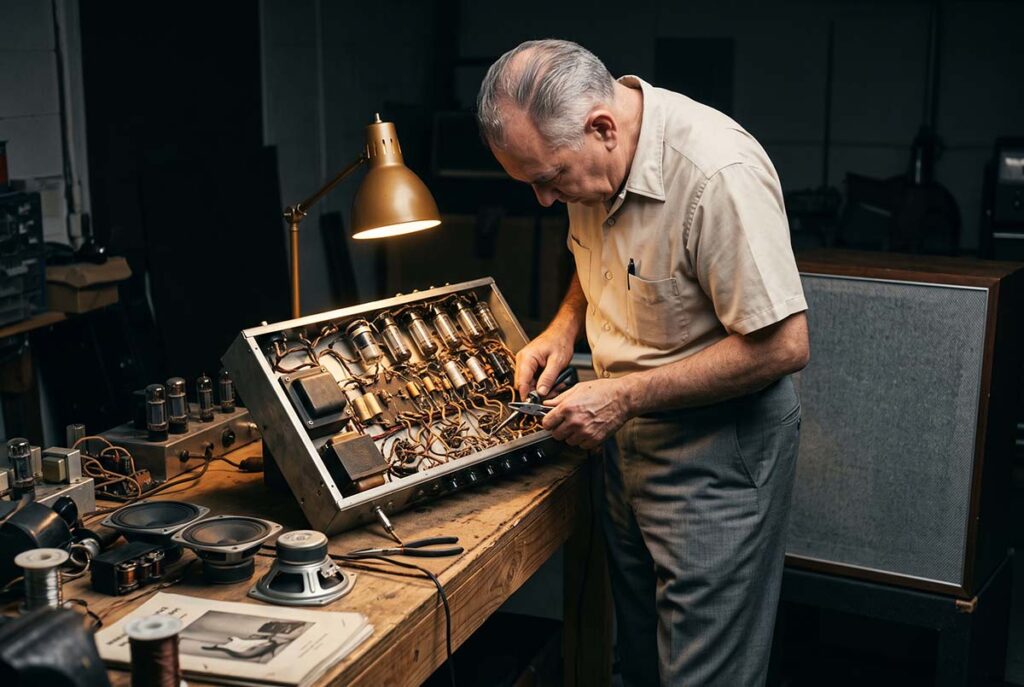
Dale’s performances turned live amplification into a stress test. Equipment that behaved perfectly under ordinary conditions could fail when confronted with the transient attack of a powerful guitarist and the acoustic pressure of a packed ballroom. Paper speaker cones, output components, transformers, and amplifier circuits were being asked to survive something much closer to sustained physical punishment than polite reproduction.
That distinction matters because rock was changing the scale of what a small ensemble could do. Four musicians could increasingly occupy an acoustic space that once required far more bodies simply by carrying enough electrical power. A small group no longer needed orchestral mass to produce overwhelming physical force. The economics of touring changed with the sound.
Leo Fender’s developing Showman system belongs to that transition. Dale’s demands helped push Fender toward more powerful amplification and tougher loudspeakers because the practical conditions of professional performance had moved beyond the assumptions built into ordinary equipment. Nobody suddenly invented loudness. The important development was a working musician forcing amplifier engineering into a range that had previously looked excessive.
The relationship between musician and manufacturer had become unusually revealing. The designer could establish a safe operating range, but the musician determined whether that range had any authority in the room where the equipment was actually used. Rock’s first great volume problem therefore carried a larger lesson. Technology could define the available boundary, but culture could refuse to recognize it.
The Razor Blade Blueprint
British musicians were colliding with the same limits by the middle of the decade. Clubs were giving way to theaters, audiences were growing, and screaming crowds could erase instruments that had seemed powerful enough only a few years earlier. More wattage addressed one part of the problem, but volume alone couldn’t create every sound musicians were beginning to imagine.
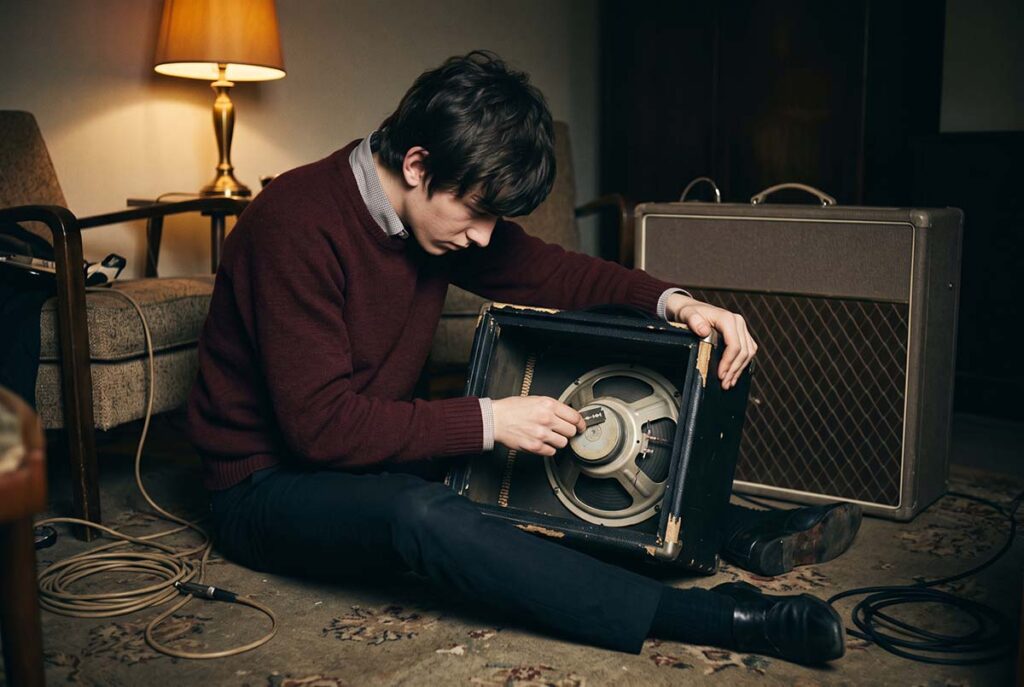
Dave Davies wanted abrasion. The clean reproduction engineers worked to preserve was precisely what he didn’t want from his small Elpico amplifier. In 1964, he took a razor blade to its paper speaker cone, deliberately reducing the speaker’s fidelity and turning physical damage into part of the signal chain associated with “You Really Got Me.”
Distorted guitar had existed before Davies, so his importance doesn’t depend on another lone-inventor myth. His decision matters because of what it says about the machine. Dale had pushed equipment until manufacturers had to solve its failures. Davies recognized that the failure itself might contain something worth keeping.
The damaged speaker therefore becomes the episode’s breaking point. What an engineer could reasonably classify as a defect became an aesthetic resource in the hands of a teenage musician. The relationship between improvement and misuse had changed. A musician no longer needed the machine to behave correctly in order for it to be useful.
The sound that would feed hard rock’s future vocabulary was vandalized into existence.
The Marshall Ultimatum
Pete Townshend was confronting another version of the same pressure by 1965. The Who played with enough physical aggression that guitar amplification had to contend with Keith Moon’s drumming, increasingly large rooms, and an audience that was itself producing considerable noise. Townshend wanted the guitar to dominate that environment rather than politely occupy a place inside it.
Jim Marshall’s London shop became one of the places where the demand acquired hardware. Townshend wanted substantially greater stage power, and Marshall’s operation moved toward 100-watt amplification in response. The number mattered less than what the additional power made possible. Once an amplifier could generate that much force onstage, it started interacting with the guitar, the room, the player’s location, and the audience. Amplification was becoming part of the performance system rather than a transparent means of making the instrument louder.
Greater power created a second problem. It had to be projected through enough speakers to move the required amount of air, and Townshend’s demands produced an enormous cabinet containing eight twelve-inch speakers. The solution made acoustic sense. It was also nearly absurd as a physical object.
Road crews had to move it.
Sawing It in Half
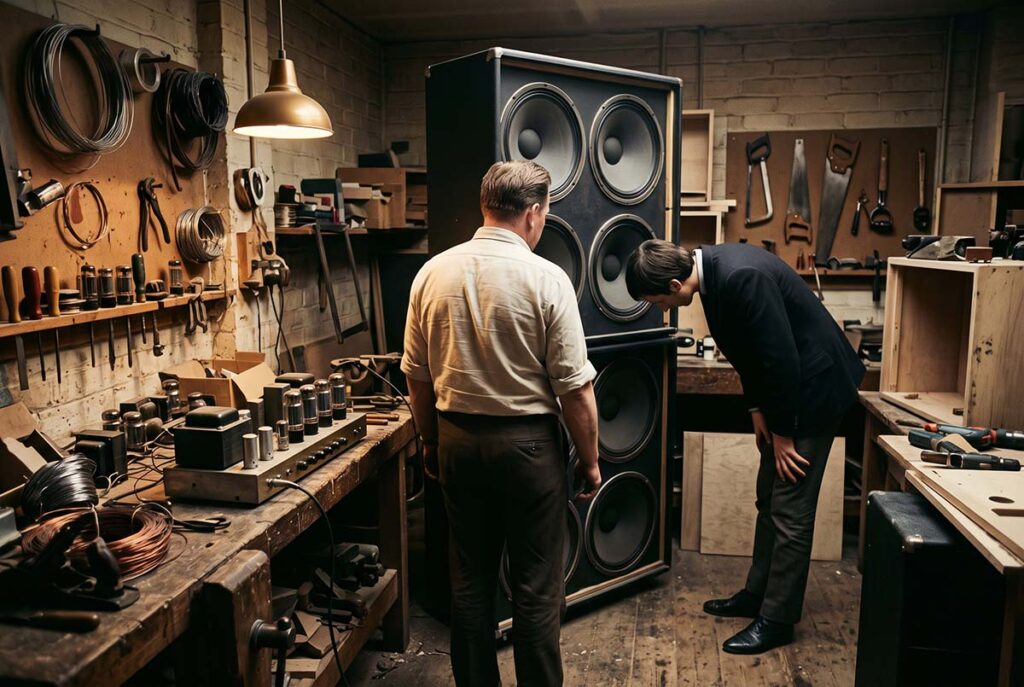
The oversized cabinet solved a musical problem by creating a labor problem. Equipment designed to fill larger rooms still had to pass through doors, fit into vehicles, and be lifted by human beings at the end of the night. That mundane fact helped produce one of the most recognizable silhouettes in rock history.
Dividing the speaker system into smaller cabinets allowed the units to be stacked vertically. What later generations would treat as the natural architecture of a rock stage emerged from a compromise between acoustic force and the limits of human labor. The stack looked monumental because the problem it solved had become monumental.
The most influential cabinet architecture in rock wasn’t born from a search for iconography. It came from making oversized equipment movable.
That practical compromise also marks the point where the series’ running technological theme becomes visible. A custom response to an unusual musician’s demand can become a repeatable object. The repeatable object becomes a product category. The breach that once depended on an individual refusing the existing standard acquires a standardized form of its own.
Musicians discover the opening. Manufacturers learn how to reproduce it.
Feedback and Wreckage
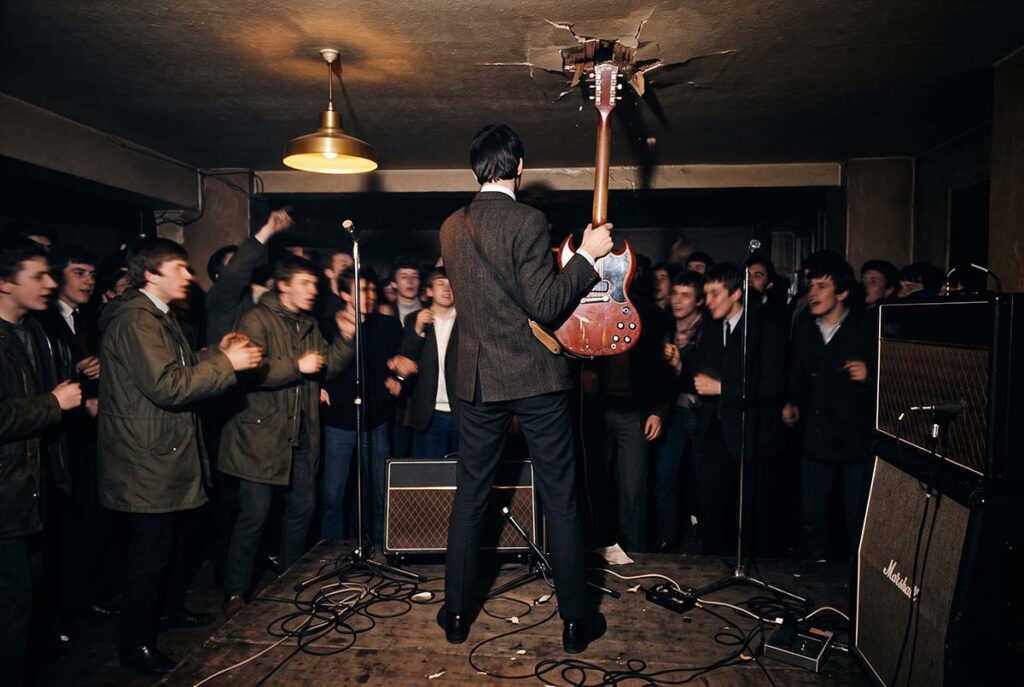
Extreme stage volume also allowed Townshend to exploit behavior that engineers had traditionally tried to suppress. Acoustic feedback occurs when amplified sound re-enters a guitar’s pickups and sustains a loop. In a system built around clean reinforcement, the loop is an error. Under a guitarist’s control, proximity, movement, volume, and position can turn it into another musical resource.
Townshend made that unwanted interaction part of his vocabulary. The amplifier was no longer merely reproducing a sound generated somewhere else in the chain. The amplified system itself could generate material for the performance. Feedback had been an engineering problem. The guitarist learned to play the problem.
The same logic soon became physical. During a 1964 performance at the Railway Hotel in the Harrow area, Townshend struck his guitar against the low ceiling. The first damage was accidental. He then completed the destruction in front of the audience.
A useful pattern had emerged. Dale encountered a limit and demanded more from the manufacturer. Davies damaged a component and preserved the result. Townshend turned unwanted electrical behavior into music and accidental physical damage into performance. Each episode began with something functioning outside its intended condition.
The musician’s response was increasingly the same: don’t restore the boundary. Use what happened beyond it.
The Commodification of Destruction

Townshend later connected his instrument destruction to Gustav Metzger’s Auto-Destructive Art, which used the destruction of manufactured objects inside a larger critique of industrial and mass-production culture. Townshend had encountered Metzger’s ideas at Ealing Art College, and the connection gave the violence onstage an intellectual context beyond simple spectacle.
Rock’s commercial machinery complicated the gesture almost immediately. Audiences began expecting The Who to destroy equipment. Once destruction became part of what people believed they were buying admission to see, the band had to keep supplying instruments that could be destroyed.
An act with anti-consumer implications had entered the consumer proposition.
Metzger’s critique had collided with the efficiency of the entertainment market. Rock could absorb opposition, reproduce it, advertise it, and sell another ticket for the next performance. What began as transgression didn’t have to lose its meaning before becoming a product. The market simply had to make the transgression repeatable.
The pattern stretched beyond instrument destruction. Increased amplifier power, deliberate mechanical distortion, controlled feedback, enormous speaker systems, and the destruction of instruments all emerged from musicians refusing the intended behavior of objects. Every refusal opened expressive territory. Every successful refusal also created something manufacturers, promoters, or audiences could ask to experience again.
Verdict
Rock’s future sound accumulated through rooms that were too loud, amplifiers that weren’t powerful enough, speakers that tore, cabinets that couldn’t be moved, feedback engineers had tried to eliminate, and instruments that were never meant to be smashed in public. None of those conditions arrived as a complete theory of where rock should go. Musicians encountered the failures one at a time and found uses for them.
The machinery had been built for a world that was disappearing. Musicians pushed it into the world replacing it. When something failed, they didn’t always repair it. Sometimes they listened.
That sound became the grammar.
Rock’s most profitable sound was the noise a piece of hardware made when it finally gave out.
Frequently Asked Questions
What did the Volume Wars actually establish about rock amplification?
The Volume Wars established that 1960s rock amplifier history was driven by musicians exceeding what existing equipment could tolerate and manufacturers responding to those demands. Dick Dale pushed amplification toward greater power, Dave Davies made speaker damage expressive, and Pete Townshend and Jim Marshall turned extreme volume into repeatable stage architecture.
Why is Dick Dale important to the history of guitar amplification?
Dick Dale’s high-volume performances at the Rendezvous Ballroom placed unusual stress on early amplification. His demands helped push Leo Fender toward the Showman system and more durable loudspeakers, making Dale a clear example of a working musician functioning as a real-world stress test for equipment design.
What did Dave Davies do to his Elpico amplifier?
Dave Davies of The Kinks deliberately cut the speaker cone of a small Elpico amplifier with a razor blade, then used the damaged unit in the signal chain associated with “You Really Got Me.” Distortion existed before Davies. His decisive move was converting mechanical damage into an intentional aesthetic resource.
How did Pete Townshend and Jim Marshall help create the Marshall stack?
Pete Townshend demanded much greater stage power and projection, and Jim Marshall’s shop responded with 100-watt amplification and an enormous eight-speaker cabinet. The cabinet proved impractical to move, so dividing the speaker load into stackable units turned a logistical problem into one of rock’s defining stage architectures.
How did feedback become part of rock music?
Acoustic feedback occurs when amplified sound re-enters a guitar’s pickups and sustains a loop. Engineers had treated that behavior as something to eliminate. At extreme stage volume, Pete Townshend learned to control it as part of performance, converting another unwanted property of amplification into musical vocabulary.
What was Gustav Metzger’s auto-destructive art, and how did it influence The Who?
Auto-Destructive Art was Gustav Metzger’s practice of using destruction as part of a critique of manufactured culture. Townshend encountered Metzger’s ideas at Ealing Art College and incorporated their logic into his stage performances. The commercial paradox arrived quickly when audiences began expecting destruction from The Who, allowing an anti-consumer gesture to become part of the product being sold.
What historical argument does The Volume Wars ultimately make?
The episode argues that loud rock’s familiar language didn’t arrive as finished technology handed down by manufacturers. Musicians pushed equipment beyond its intended function, discovered expressive possibilities inside malfunction, and forced industry to catch up. Those improvised transgressions then became standardized equipment, stage architecture, and commercial spectacle.
Why did Bob Dylan going electric become the next major argument in rock history?
Episode 8 moves the technological argument from amplifier power to musical legitimacy. The American folk revival had built a political culture around acoustic tradition, authenticity, and collective ownership. Bob Dylan’s 1965 Newport electrification turned an electric guitar into a dispute over who had the authority to decide what folk music could become.