Episode 9: The Invisible Church – Spirituals, Ring Shouts, and Music Beyond Surveillance
This is Episode 9 of Music and the Moral Panic, examining how hush harbors and plantation surveillance exposed a limit within slavery’s extraordinary claim over human life. Enslaved African Americans remade Protestant Christianity through spirituals, ring shouts, African-derived movement, collective worship, and layered meaning, creating a religious world that white institutions could constrain physically without fully controlling its interpretation. When secluded worship became an acoustic problem, ordinary objects such as iron pots and heavy quilts were used in efforts to contain its sound. Enslaved people remained legally and materially enslaved, yet the institution couldn’t make possession total because it couldn’t monopolize the meanings communities created together in song.
The Machinery of Total Domination
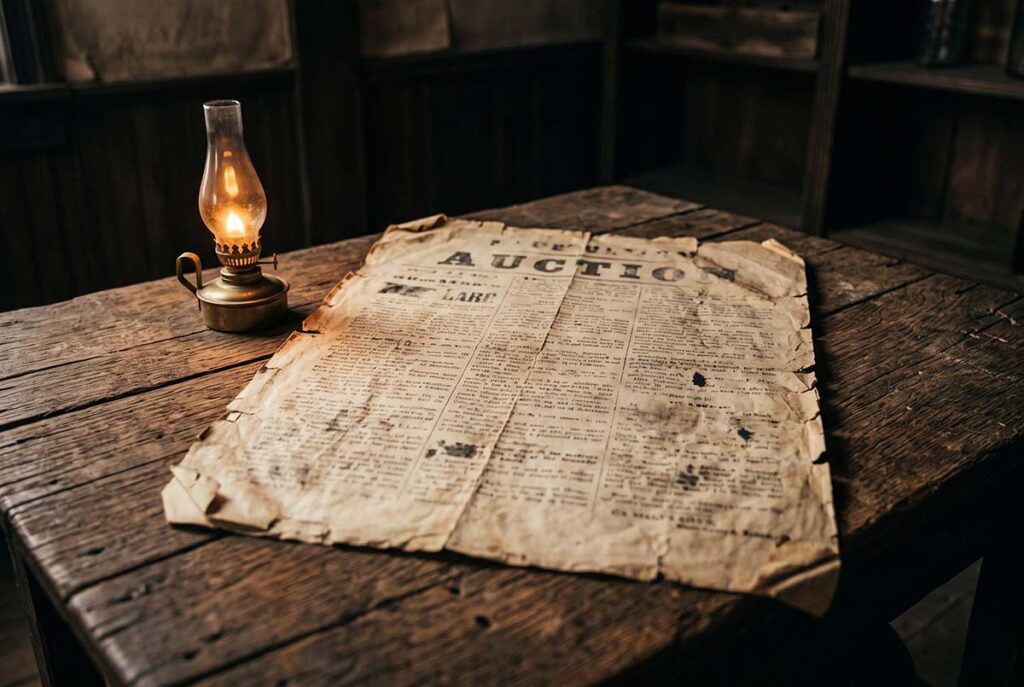
An auction broadside from antebellum New Orleans reduces human beings to commercial inventory. Men appear with the cold specificity normally reserved for merchandise, classified by age, capacity, and physical condition. The document belongs to a legal and economic order that transformed ownership of another person into an enforceable commercial fact. Slavery’s violence rested partly on that conversion: the law declared a human being property, and institutions were constructed to make the declaration materially real.
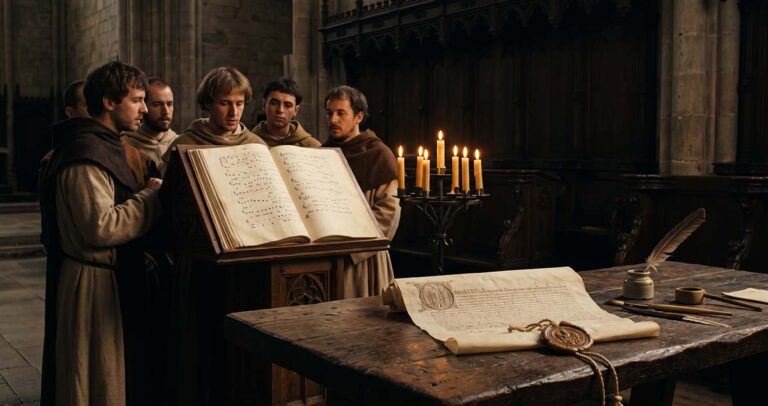
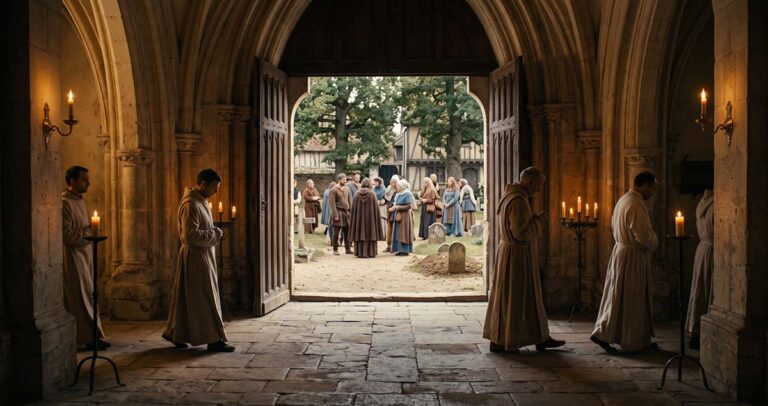
The plantation system’s ambitions reached far beyond extracting labor. It claimed bodies, movement, time, geography, and the terms under which people could assemble. Religious life entered the same structure. Protestant missionaries, plantation churches, and white-controlled worship supplied a Christianity in which certain interpretations of Scripture carried obvious political usefulness, especially those that presented obedience to earthly masters as religious duty.
The whip enforced submission from outside. Theology was expected to make that submission intelligible from within. That ambition encountered a problem more fundamental than disobedience. Physical possession gave the institution enormous coercive power, but it couldn’t dictate what every listener eventually made of the words being preached.
The gap between administration and interpretation became large enough for another religious world to develop inside the system that claimed ownership over the people creating it.
The Public Transcript
White-controlled Christianity supplied biblical vocabulary to enslaved communities, but vocabulary doesn’t arrive with permanent ownership of its meaning. Exodus, bondage, judgment, Canaan, Pharaoh, deliverance, and freedom belonged to Christian theology. Inside communities living under literal bondage, those ideas inevitably entered a different field of experience.
The religion that emerged through Black worship in the Americas was neither European Protestantism preserved intact nor an untouched African religion surviving beneath a Christian disguise. African-derived forms of musical organization, movement, memory, communal participation, and spiritual practice recombined with Protestant materials. The result was a religious culture being shaped by the people practicing it rather than simply administered by the people who had introduced its vocabulary.
That distinction created a persistent institutional problem. Plantation authorities could regulate services, approve ministers, determine which passages were emphasized, and demand outward conformity. Enslaved worshippers could hear the same biblical stories and organize them around very different understandings of bondage, justice, divine authority, community, and eventual deliverance.
The institution controlled access to Scripture far more easily than it controlled interpretation. It possessed the legal system and the pulpit, yet meaning remained a separate jurisdiction.
The Kongo Cosmogram in Motion
Episode 8 ended with colonial authorities treating the drum as a communication technology. South Carolina’s Negro Act of 1740 emerged from a world in which African drumming was understood to carry information across distance and assist collective organization. Suppressing the instrument removed one technology. Rhythm survived in the people who had known how to organize it.
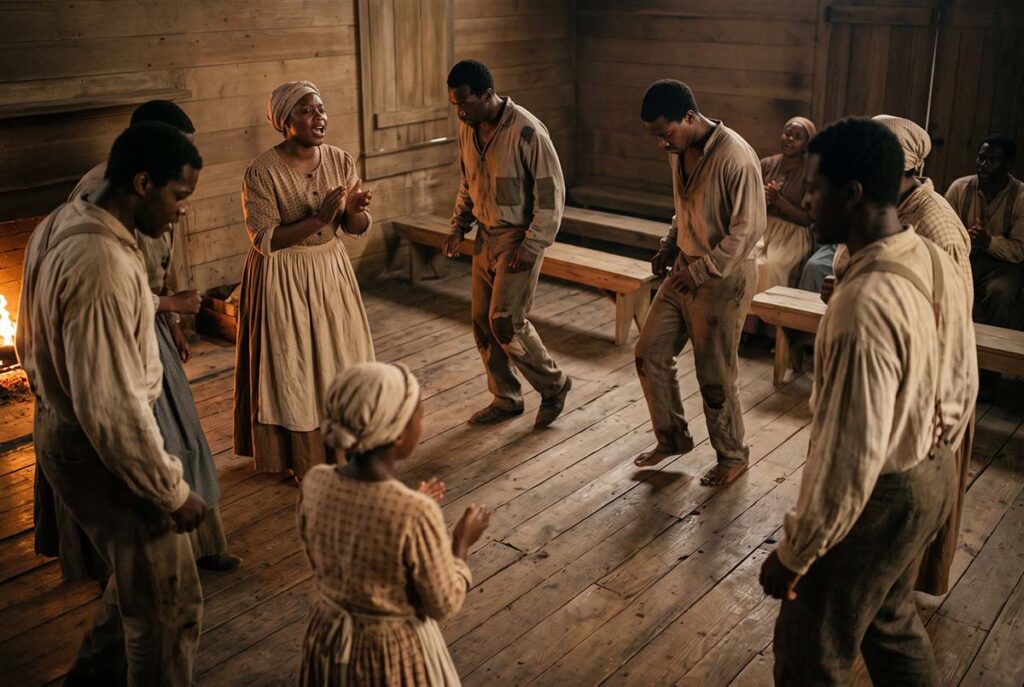
Within African American sacred practice, the body itself could become musical infrastructure. Hands clapped time. Feet stamped and shuffled. Voices answered other voices. In the ring shout, participants moved together through a circular pattern while singing, clapping, and maintaining a dense rhythmic organization that required no conventional percussion instrument.
The practice endured with particular strength among Gullah Geechee communities of coastal South Carolina and Georgia, where cultural and geographic conditions preserved deep continuities with West and Central African traditions. The inheritance lived in more than lyrics. It remained present in the way bodies organized sound, movement, time, and community together.
The episode interprets this circular sacred movement through the Kongo cosmogram and the Kalûnga line, a Central African cosmological framework concerned with relationships among life, death, ancestry, and the spiritual world. Such knowledge didn’t require a printed text or institutional building to remain meaningful. People could carry it through movement, spatial organization, sound, and collective memory.
An overseer could watch bodies moving in a circle and still miss much of what the circle meant. The body was visible. Its cultural grammar was another matter.
Surveillance could record movement without acquiring comprehension.
The Hush Harbor
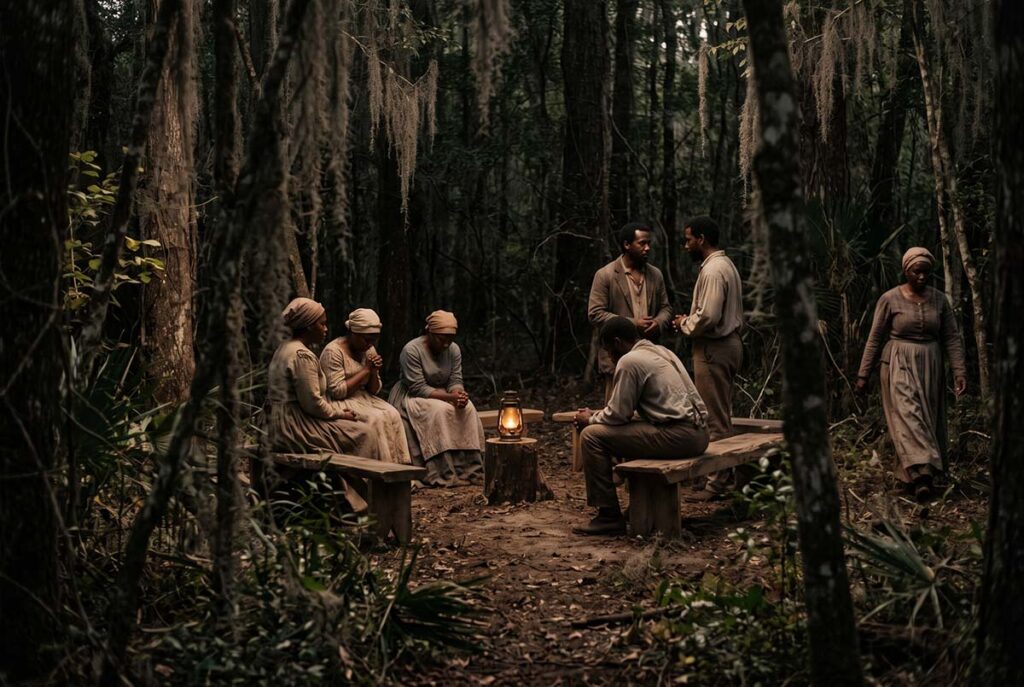
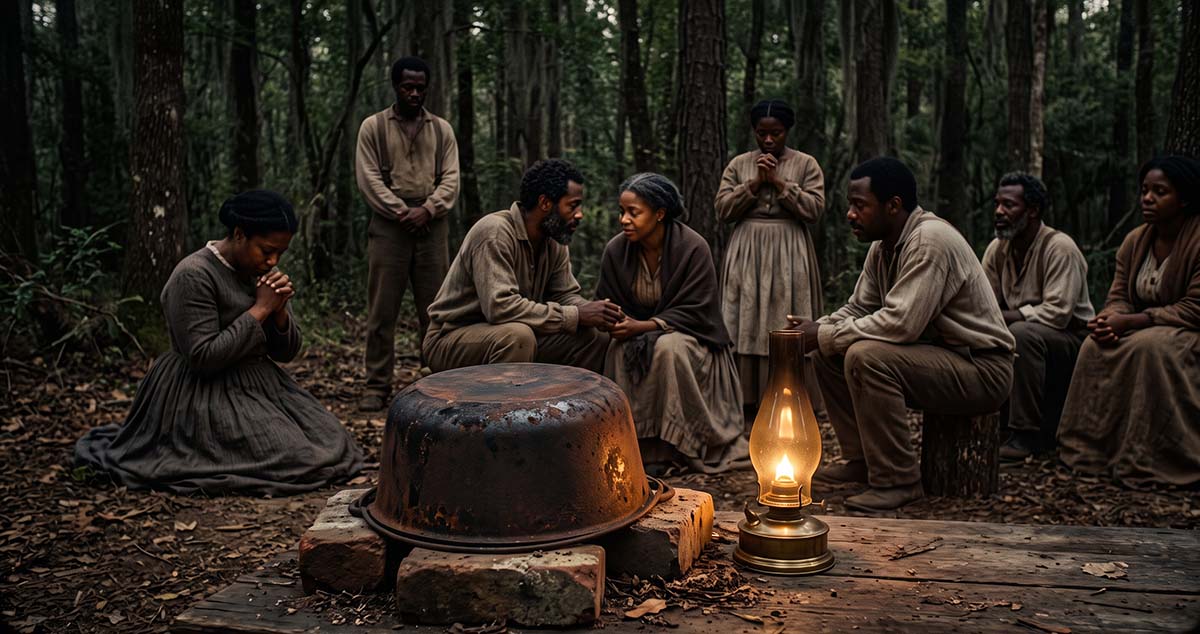
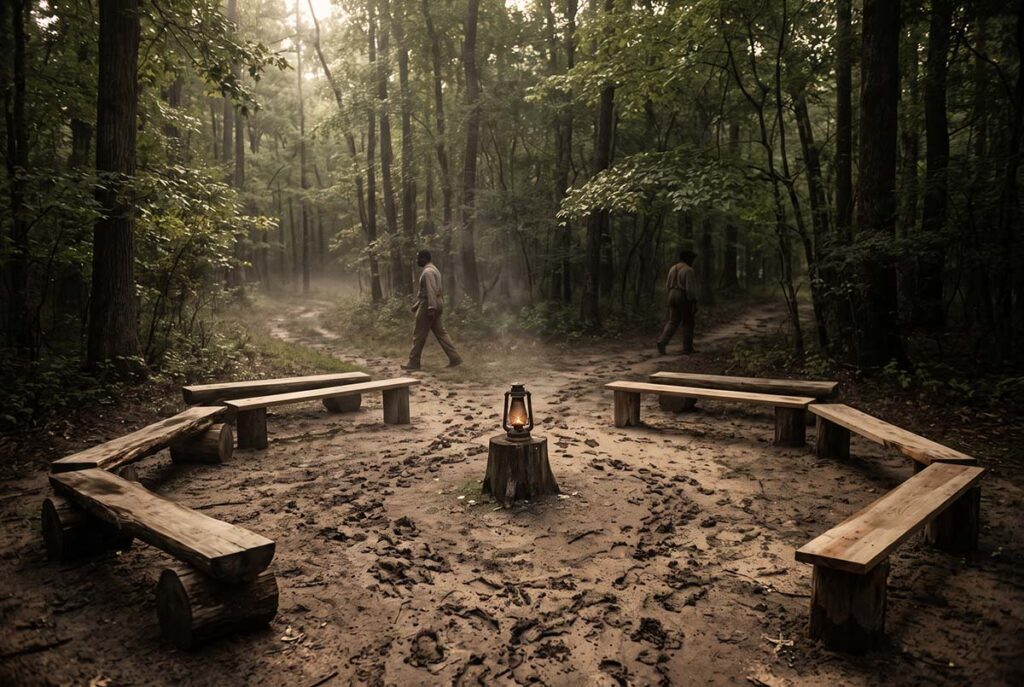
Independent Black worship altered the location of religious authority. Where autonomous gathering couldn’t safely occupy formal religious space, worship sometimes moved toward wooded clearings, ravines, swamps, brush arbors, and other secluded areas at the margins of plantation geography. Later scholarship commonly groups some of these spaces under the term “hush harbors,” though practices and terminology varied by region and period.
The seclusion shouldn’t be romanticized. People didn’t gather in woods or swamps because secrecy made worship picturesque. The landscape itself reflected coercion. Autonomous Black assembly could be dangerous enough that religious community had to occupy places where direct white supervision became more difficult.
Within those gatherings, authority could temporarily shift toward the people assembled there. They could determine the prayer, the rhythm, the response, and the interpretation. Plantation power still surrounded the gathering and retained overwhelming control over material life, but its jurisdiction became less complete within the shared act of worship.
Distance from the overseer’s sight created another problem. Prayer had volume. Singing carried through darkness. Clapping, shuffling feet, and communal response could travel farther than the bodies producing them.
The question was no longer simply whether the gathering could remain unseen. Sound itself had become evidence.
The Pot, the Quilt, and the Encrypted Message
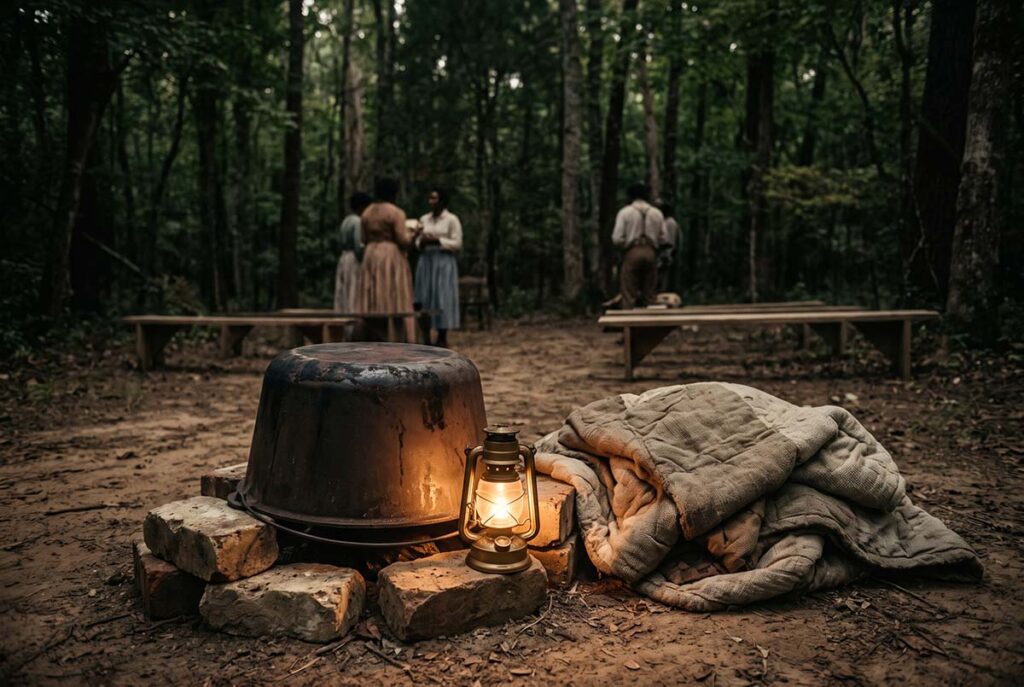
The response was practical. The production record describes efforts to contain the sound of secluded worship with materials people could obtain in ordinary domestic life, including heavy iron pots and damp quilts. Voices could be directed toward an inverted vessel or muffled beneath heavy fabric. Whatever reduction these methods achieved, the historical significance lies in the attempt itself: people living under extraordinary surveillance were deliberately modifying their acoustic environment so communal worship could continue.
Here the limits of suppression become physically visible. Plantation power possessed property law, organized violence, economic authority, and control over where human beings could live and move. The countermeasure could be a cooking pot.
The most controlled people in American history built their sovereign world with a cooking pot.
Spirituals carried a related form of complexity. They were an oral sacred tradition shaped by Christian theology and the experience of enslavement. Biblical images of Jordan, judgment, bondage, Exodus, and deliverance could resonate across several layers of meaning at once. A song didn’t have to stop being devotional in order to carry social, emotional, political, or situational significance.
Some songs could carry concealed information in specific circumstances. Traditions surrounding “Steal Away to Jesus,” for example, include associations with clandestine gathering. The historical record supports that kind of layered and situational communication more securely than the familiar story of a universal Underground Railroad codebook.
The distinction matters. Spirituals weren’t a standardized system in which every biblical image corresponded to a fixed route, time, or instruction. Lyrics varied, communities differed, and meaning depended on circumstance. Turning the tradition into a mechanical cipher makes it simpler than the evidence allows.
Its actual communicative power was more fluid. Outsiders might hear recognizable Christian language while the people singing brought additional communal knowledge to it. The institution could hear the song without owning the interpretation.
It had built a surveillance apparatus capable of hearing almost everything and understanding far less.
The Invisible Institution
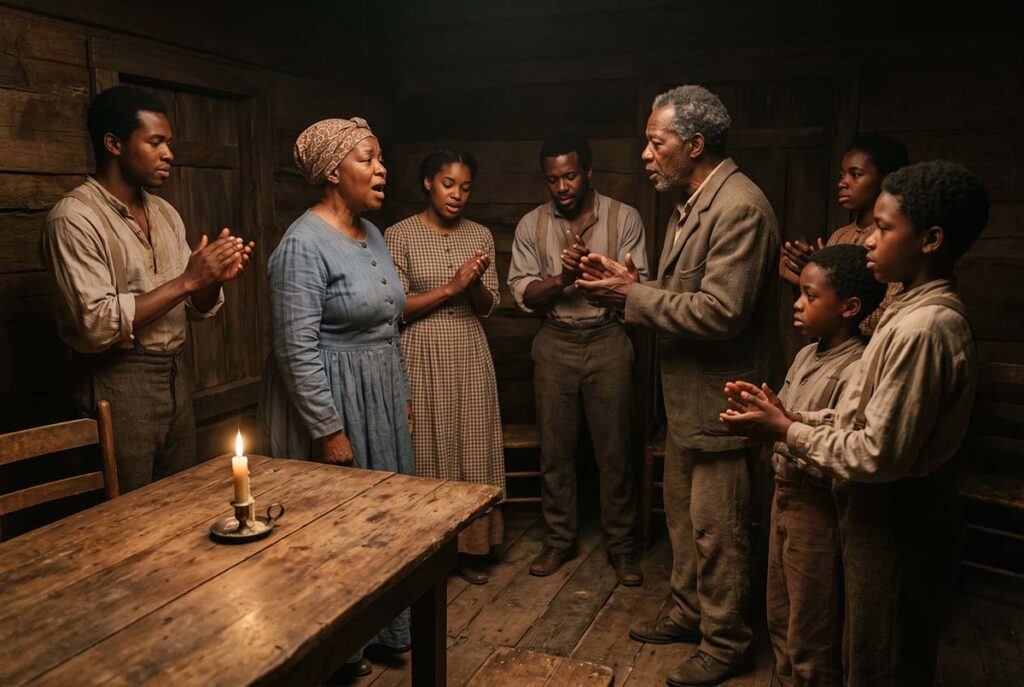
Scholars including E. Franklin Frazier, C. Eric Lincoln, and Albert Raboteau have described the autonomous Black religious world created under slavery through the concept of the “invisible institution.” The phrase doesn’t identify a secret denomination with a hidden headquarters. It describes a religious and communal world operating within, alongside, and sometimes beyond white-controlled institutions.
Its infrastructure could be remarkably difficult to seize because so much of it existed in people rather than buildings. Rhythm could live in bodies. Theology could travel through remembered songs. Historical knowledge could move orally. Shared interpretation could be renewed each time a community gathered.
That gave the institution a kind of resilience that permanent physical infrastructure often lacks. Authorities could remove a drum while leaving rhythmic knowledge intact. They could supervise a sermon while losing control over what its symbols meant once worshippers carried them elsewhere. They could patrol roads without occupying every remembered song.
None of this made Black religious autonomy safe. Enslavers remained capable of surveillance, punishment, forced separation, and violence. Hush-harbor worship didn’t exist outside slavery’s material reality.
Its significance comes from existing inside that reality.
Complete physical domination still failed to produce complete interpretive domination. The system had converted people into property under law, yet some dimensions of human life remained beyond the practical reach of ownership. The invisible institution was evidence of that boundary.
And it functioned.
The Verdict
Chattel slavery made one of the most comprehensive claims over human life in American history. It controlled labor through violence, restricted movement, regulated assembly, governed physical geography, bought and sold bodies, and attempted to place religious authority inside the same structure of ownership. Its power over material life was real enough to make any romantic interpretation of this history untenable.
Spirituals, ring shouts, hush harbors, African-derived cosmology, collective worship, and oral memory reveal something that the legal category of property couldn’t fully contain. Plantation authority could compel outward behavior. It couldn’t automatically determine what people understood a song to mean, what histories their bodies carried, or what kind of community came into existence when one voice called and another answered.
Music didn’t make enslaved people legally or materially free. The plantation remained violent, and bondage remained brutally real. What these practices preserved was a domain whose meaning couldn’t be made entirely the institution’s property.
That distinction exposes a weakness inside the language of ownership itself. Law may define a human being as property. Violence may enforce the definition across nearly every visible part of daily existence. Meaning still has to be made somewhere, and people continued making it together.
Gathering mattered because meaning was communal. Song mattered because it could pass between people without requiring the institution’s permission to understand it. Those capacities remained constrained, punishable, and vulnerable, but they persisted.
The next episode carries the same problem into another American setting. In 1889 and 1890, Wovoka’s Ghost Dance movement confronts federal authorities with ceremonial song and movement they can’t confidently interpret. Plantation surveillance had already demonstrated one limit of institutional comprehension. On the Plains, the response would move toward military force.
The law claimed the body. It could not enter the world assembled in song.
Frequently Asked Questions
What were hush harbors during slavery?
Hush harbors were secluded places where enslaved African Americans sometimes gathered for comparatively autonomous worship beyond direct white supervision. They could include wooded clearings, ravines, swamps, or brush arbors. The term doesn’t describe one standardized institution across the South. Practices varied by geography, community, and historical period.
What was a ring shout?
The ring shout was an African-derived sacred practice combining collective circular movement, call-and-response singing, clapping, rhythmic footwork, and sometimes percussion. It survived with particular strength among Gullah Geechee communities. Its importance lies partly in showing that African cultural continuity survived through movement, rhythm, participation, communal organization, and words.
What is the Kongo cosmogram and how does it relate to the ring shout?
The Kongo cosmogram is a Central African cosmological framework associated with cycles of life, death, and ancestral relationship. The episode interprets the counterclockwise movement of the ring shout through this tradition and the Kalûnga line, showing how inherited religious knowledge could be embodied through movement without written texts, formal instruments, or institutional buildings.
Were spirituals secret codes for the Underground Railroad?
Some spirituals could carry layered, situational, or concealed meanings, and particular songs were associated with communication inside enslaved communities. Surviving evidence doesn’t establish a universal Underground Railroad codebook in which familiar spirituals systematically mapped routes or instructions. Their meanings were fluid and contextual, sometimes religious, social, emotional, political, or covert.
What does the phrase “invisible institution” mean?
Scholars of the Black church use the phrase to describe an autonomous African American religious and communal world operating partly within, alongside, and outside white-controlled religious institutions. It wasn’t a literal secret denomination. Its infrastructure could consist of sound, movement, oral memory, shared interpretation, participation, and temporary gathering rather than permanent buildings or centralized organization.
What did this episode actually establish about slavery and cultural control?
Enslaved people remained subject to violent legal and material domination. The episode establishes that this physical control didn’t guarantee interpretive control. Slave law could regulate bodies, movement, assembly, and worship while still failing to determine completely what scripture, rhythm, memory, or collective song meant.
Why does the history of spirituals and hush harbors matter beyond music history?
The episode separates surveillance from comprehension. Institutions may regulate physical behavior while remaining unable to monopolize meanings communities create from shared symbols and practices. That distinction matters throughout the series because later authorities repeatedly encounter music they can hear, observe, regulate, or punish without fully understanding what it communicates to the people making it.
What happened when American authorities encountered the Ghost Dance in 1889 and 1890?
The next episode examines Wovoka’s Ghost Dance movement, where ceremonial song and collective movement confronted federal authorities with another cultural language they couldn’t confidently interpret. The institutional response escalated beyond surveillance. At Wounded Knee in December 1890, incomprehension and fear became entangled with military force, extending the communication problem examined here.