Episode 8: The Drum Becomes Contraband – Colonial Suppression of African Music and Communication
This is Episode 8 of Music and the Moral Panic, examining why the Negro Act of 1740 placed drums and other loud instruments inside South Carolina’s wider system for controlling enslaved movement, assembly, weapons, literacy, and communication. The law followed the Stono Rebellion of 1739, when drumming accompanied a southbound column of rebels, although colonial drum restrictions already existed elsewhere in the English Atlantic. Section 36 makes South Carolina’s importance unusually clear because lawmakers explicitly identified instruments capable of calling people together or transmitting signs and notice. The colonial state was extending plantation surveillance into an acoustic network that could connect people beyond physical supervision.
September Morning on the Pon Pon Road
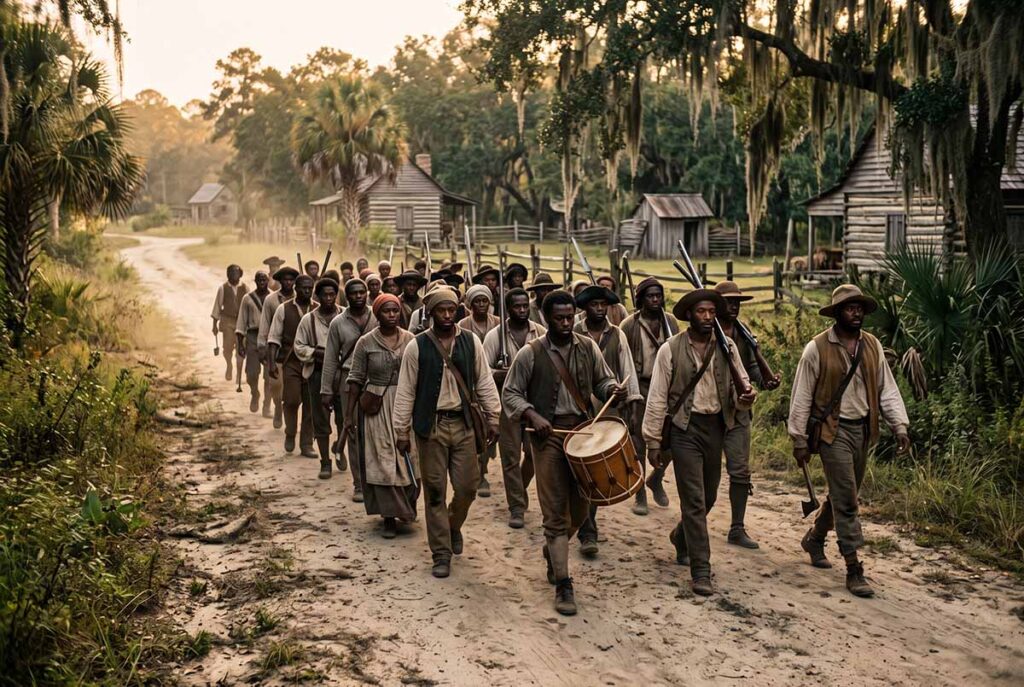
On the morning of September 9, 1739, twenty enslaved men began moving south along the Pon Pon Road in South Carolina to the deliberate cadence of a drum. Around them lay the Carolina Lowcountry, a landscape of rice plantations, rivers, roads, and extraordinary colonial wealth built through captive African labor. It was also a landscape organized around surveillance. Enslaved people required permission to move away from plantations, armed patrols watched the roads, and property boundaries helped determine where people could travel and gather.
That machinery reflected a basic demographic fact. In parts of the Lowcountry, enslaved people vastly outnumbered those who enslaved them, and colonial authorities understood the political meaning of that imbalance. Movement had to be visible. Meetings had to be controllable. Connections between plantations had to remain subject to white supervision.
The previous episode in this history concerned another problem of assembly. Parliament could close London’s theaters because the crowd occupied a physical place. Doors could be shut, stages silenced, and gatherings dispersed. South Carolina confronted a harder problem because people didn’t always need to occupy the same room, road, or field to communicate.
The state could inspect a pass and patrol a road. Sound moved above both.
The colonial plantation was an airtight physical cage with a porous acoustic ceiling.
The Cage With a Porous Ceiling
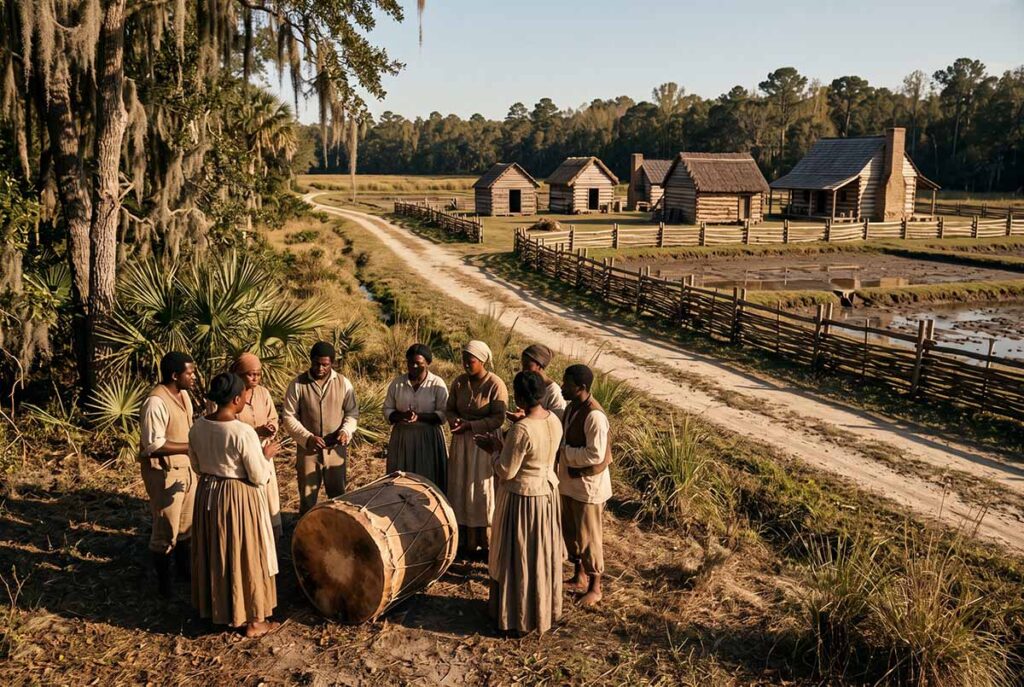
African musical traditions carried into the Americas served purposes that exceeded the European category of entertainment. Across parts of West and West Central Africa, percussion belonged to ceremonial, social, and communicative systems in which patterned sound could organize collective activity and carry information beyond ordinary speaking distance. The precise techniques varied by culture, but the larger fact mattered inside a plantation society built around physical separation. Sound could travel without presenting itself to a patrol.
That exposed a structural weakness in colonial surveillance. An overseer could stop a person moving along a road and demand written authorization. Property lines could separate one plantation from another, and armed patrols could police the routes between them. None of those mechanisms could force an auditory signal to stop at a surveyed boundary.
The plantation’s surveillance system had been designed for bodies moving through physical space. Acoustic communication operated under different rules.
South Carolina wasn’t the first English colony to confront that problem. Restrictions on African drumming appeared elsewhere in the plantation Atlantic before 1740, including Caribbean jurisdictions where authorities associated unsupervised gatherings and loud instruments with communication beyond direct supervision. That earlier history matters because Stono didn’t suddenly teach colonial governments that drums could have political uses. South Carolina entered an existing Atlantic pattern and then documented its own fear with unusual precision.
The familiar version of the story is cleaner than the record. Rebels beat drums at Stono, frightened slaveholders responded, and the drum was banned. The archive points toward something broader: a colonial state already committed to restricting independent communication encountered a rebellion in which sound accompanied people moving, gathering, and recruiting beyond the ordinary boundaries of plantation control.
The Drum as Deployed Technology
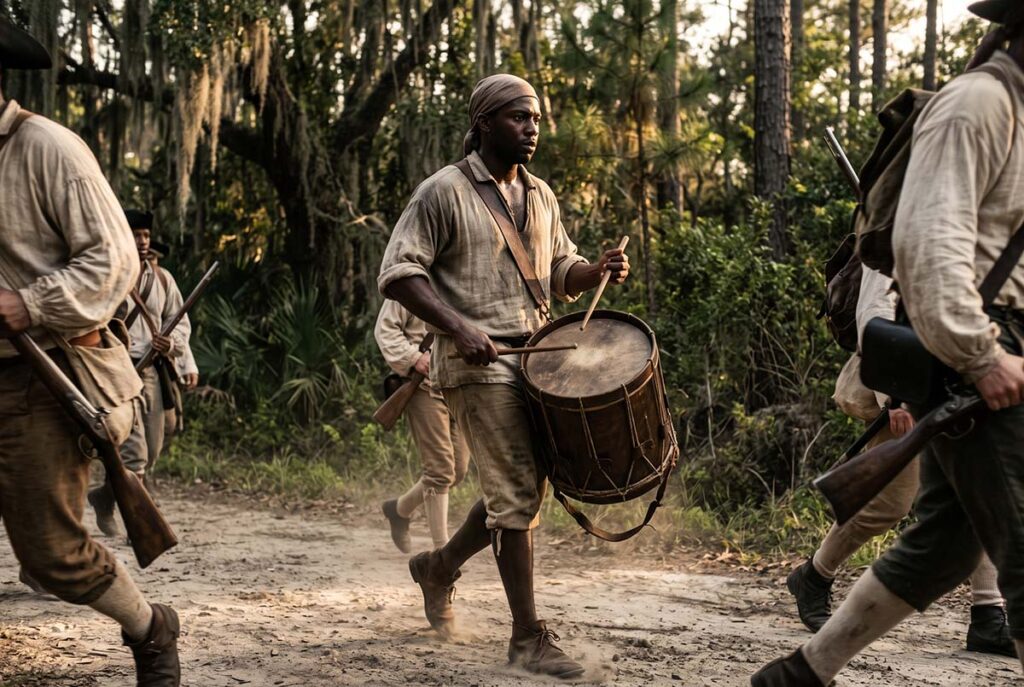
The rebels moving south in September 1739 were heading toward Spanish Florida, where imperial rivalry had created a possible route to freedom for fugitives from British slavery under specified conditions. Scholars have also examined the Central African backgrounds of many Stono participants and the possibility that some carried experience shaped by Kongolese military and Catholic traditions. Their rebellion emerged from a particular Atlantic world, not from an isolated eruption inside South Carolina.
As the column moved, the rebels seized weapons, attracted additional participants, raised banners, and beat drums. The drum wasn’t decoration added to the rebellion afterward. It belonged inside the moving event.
The evidence doesn’t require a stronger claim than the record can support. Historians haven’t reconstructed a complete coded drum language used to coordinate every phase of Stono. What survives is sufficient: drumming accompanied the march, the column grew as it traveled, and South Carolina lawmakers soon identified loud instruments capable of summoning people and transmitting notice as a security problem.
That relationship between hearing and understanding mattered. Plantation authorities could recognize that communication was taking place without necessarily knowing its content, its recipients, or its consequences. Surveillance could observe bodies and still fail to possess the information passing among them.
The drum exposed that gap. The following year, the colonial government tried to close it through law.
Section 36
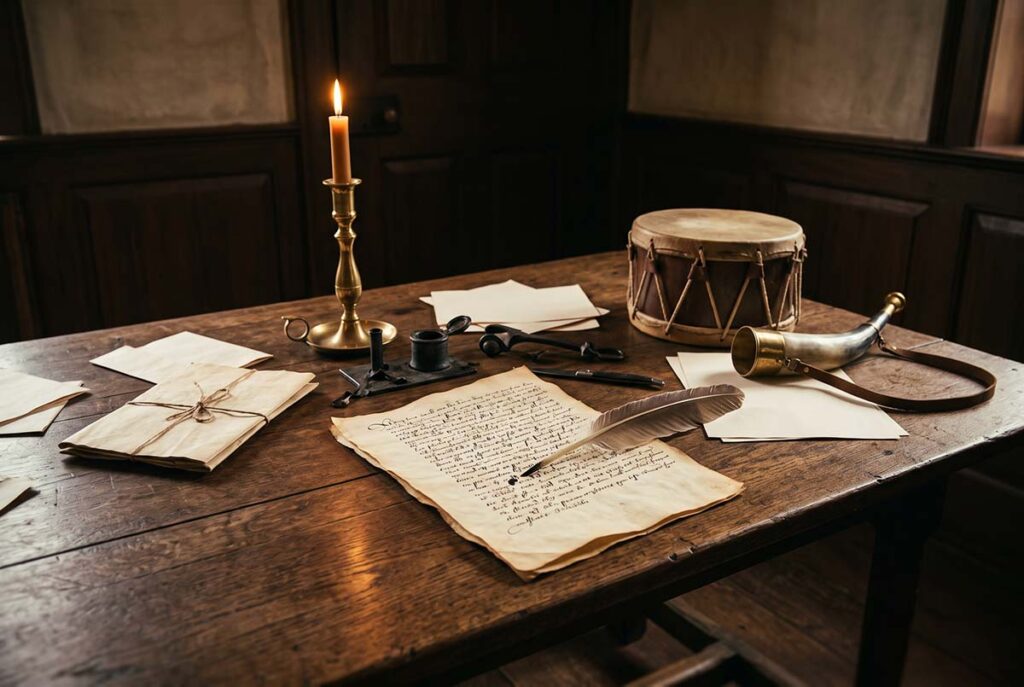
In May 1740, South Carolina enacted a sweeping revision of its slave code. The law regulated far more than musical instruments. It operated within an extensive structure governing enslaved movement, meetings, literacy, economic activity, weapons, travel, and other forms of autonomy. Section 36 belongs inside that larger system.
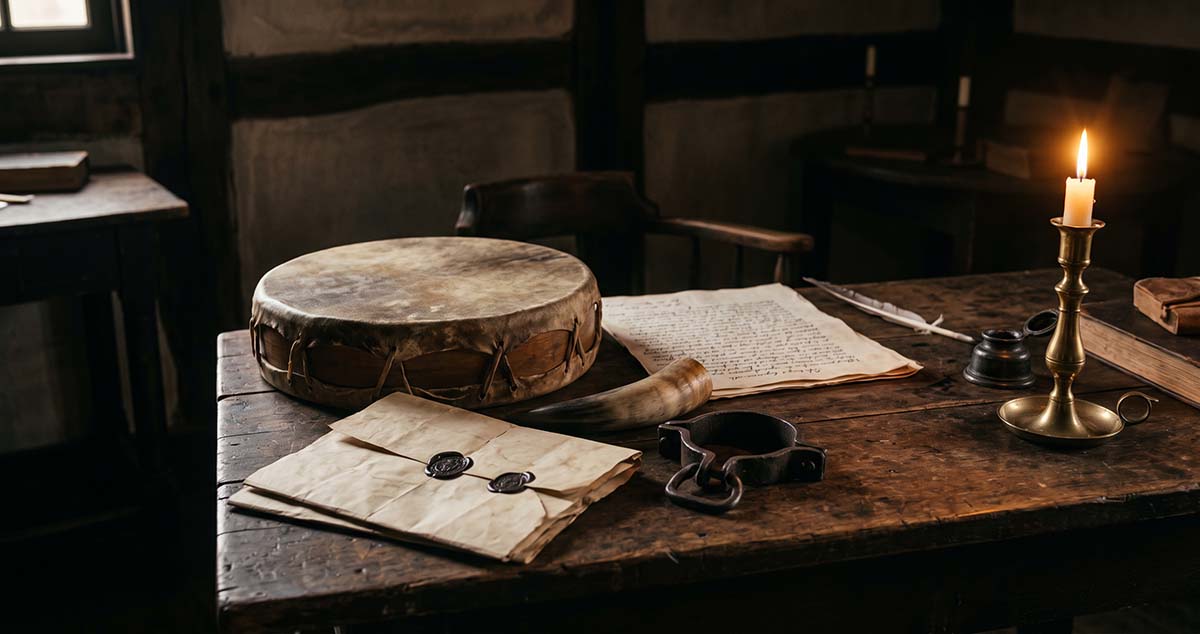
The provision restricted drums, horns, and other loud instruments, and the lawmakers stated their concern with unusual clarity. Such instruments could allow enslaved people to call one another together or give signs and notice. The objection was functional. Sound could connect people whom the plantation regime was attempting to keep observable, separated, and dependent upon supervised channels.
Seen by itself, the drum provision can resemble an eccentric episode in the history of censorship. Placed beside restrictions on roads, passes, gatherings, literacy, boats, weapons, and unsupervised movement, it becomes part of something more systematic. The colony was regulating the means by which people could establish relationships and exchange information outside white control.
No theory of corrupting melody was required. The Assembly didn’t need to claim that rhythm damaged morals or offended good taste. A loud instrument became dangerous because it could summon people and transmit information.
Section 36 therefore placed acoustic communication within the same security world as prohibited meetings and weapons. Under conditions of forced isolation, a drum could become infrastructure.
The state was trying to dismantle a network.
What Survived the Ban
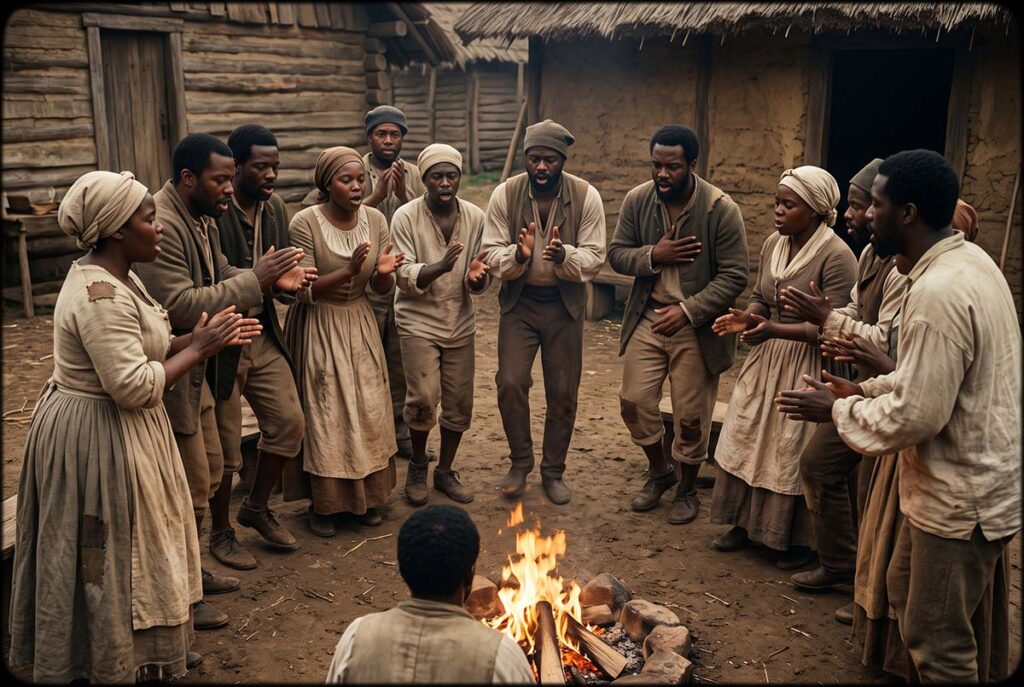
A government can restrict possession of an instrument more easily than it can eliminate the knowledge people carry in memory and in their bodies. Enslaved communities continued making music and sustaining communal practices under conditions deliberately constructed to limit autonomy. Those surviving traditions shouldn’t be reduced to untouched African relics, nor should the Negro Act be made into the single cause of everything that followed in Black American music.
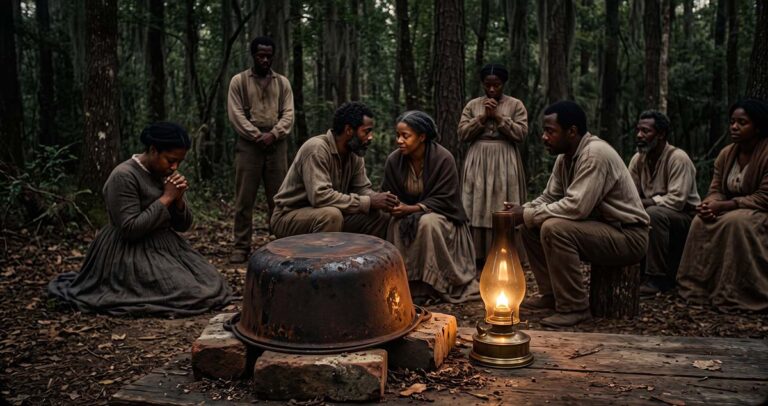
Restriction still changed the environment in which musical knowledge survived. Rhythmic organization could move into clapping, footwork, bodily percussion, voice, and collective worship when particular instruments became dangerous to possess or use. Ring shout traditions preserved communal movement and rhythmic participation within African-derived religious life. Patting Juba relocated percussion into hands, legs, and the human body.
Section 36 could name drums and horns. The body remained harder to confiscate.
Plucked-string traditions also continued among enslaved Africans and their descendants and contributed to the early American history of instruments that became the banjo. These histories reached toward West African antecedents while developing under conditions specific to the Americas. Coercion reshaped cultural practice, but it didn’t produce a simple line of mechanical cause and effect.
The 1740 law didn’t create Black American music. It narrowed part of the acoustic environment in which Black musical culture developed. Some practices were constrained, some adapted, and some continued in forms colonial authorities couldn’t eliminate as easily as a physical drum.
A revealing parallel appears in seventeenth-century Pueblo New Mexico, though the two histories shouldn’t be collapsed. Spanish colonial and missionary authorities persecuted Pueblo religious and ceremonial practices within a different legal, racial, and theological system. Pueblo ceremony nevertheless carried memory, communal authority, and relationships that colonial rule couldn’t simply replace by decree.
That is one of prohibition’s recurring limits. Institutions can change the conditions under which culture survives and force practices into different spaces or forms. Destroying or restricting an object doesn’t automatically destroy the knowledge carried through it.
The Verdict
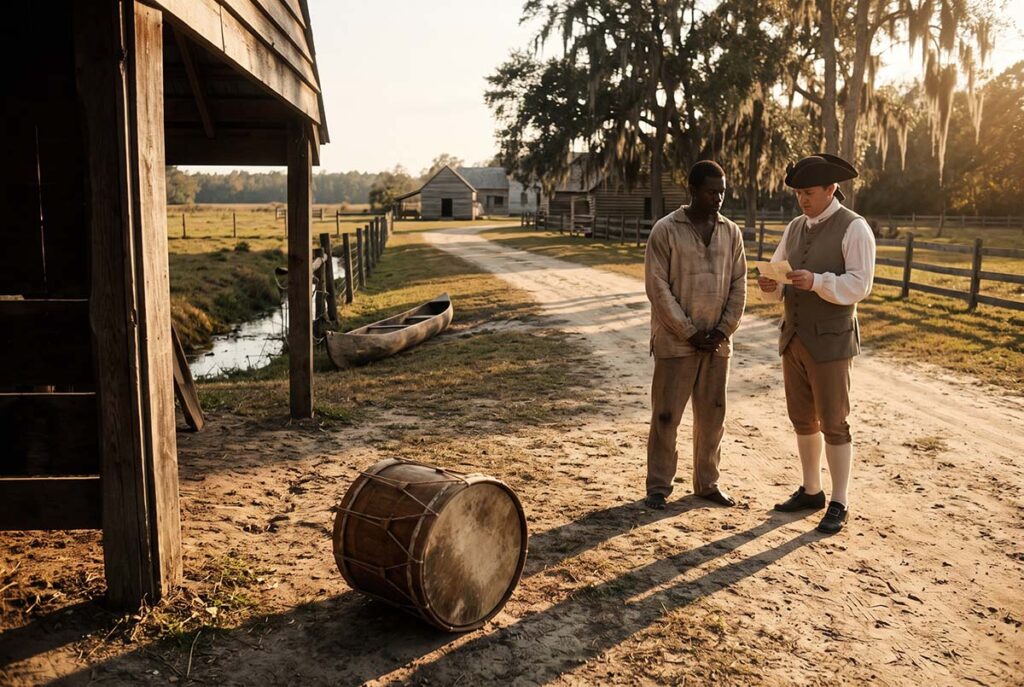
The Negro Act of 1740 survives as evidence because governments record what they attempt to control. South Carolina’s legislators placed loud instruments inside a wider structure regulating communication, assembly, movement, and security, then explained why those instruments concerned them. Their own language gives the episode its force.
The statute reveals a vulnerability inside a government that possessed extraordinary power over labor, property, travel, and physical space. Enslaved people could still establish connections that crossed the boundaries of the plantation system. Colonial authorities might hear those connections without fully controlling what they carried.
The answer was to extend surveillance into the acoustic environment.
That mechanism changes in the next stage of the story. Enslaved communities develop spirituals, ring shouts, African-derived worship practices, and parallel forms of communal life that can operate beyond ordinary white supervision or survive in plain hearing without yielding their full meaning. The state’s problem becomes more difficult when communication moves from a confiscatable instrument into voice, movement, worship, and shared understanding.
A physical drum can be prohibited. A communal language embodied in people is harder to seize.
When a government writes a drum into the same statute as a weapon and a forbidden meeting, it has already confessed what it fears most: people finding one another without permission.
Frequently Asked Questions
Why did South Carolina restrict drums under the Negro Act of 1740?
South Carolina lawmakers feared that drums, horns, and other loud instruments could help enslaved people communicate beyond direct supervision. Section 36 connected such instruments with calling people together and transmitting signals. The restriction belonged to a broader security system controlling movement, meetings, weapons, literacy, trade, and other forms of autonomy.
What was the Stono Rebellion, and what role did drumming play in it?
The Stono Rebellion began on September 9, 1739, when enslaved people gathered near the Stono River in South Carolina and moved south toward Spanish Florida. They seized weapons, attracted additional participants, and beat drums during the march. The evidence establishes drumming as part of the moving rebellion without proving a reconstructed system of coded messages.
What was Section 36 of the Negro Act of 1740?
Section 36 restricted drums, horns, and other loud instruments among enslaved people in South Carolina. Its significance comes from the lawmakers’ stated rationale that such instruments could call people together or transmit signs and notice. That language places sound directly inside the colony’s larger architecture of communication control.
Did South Carolina invent colonial bans on African drumming after the Stono Rebellion?
No. Restrictions on African drumming existed elsewhere in the English Atlantic before South Carolina’s 1740 law, including Caribbean jurisdictions concerned with gatherings and signalling. South Carolina matters because its statute articulated the fear of acoustic communication with unusual clarity and connected it directly to provincial security.
What does the episode mean by the plantation having a “porous acoustic ceiling”?
The phrase describes a basic weakness in plantation surveillance. Authorities could patrol roads, inspect passes, restrict gatherings, and enforce property boundaries, while sound continued across those physical controls. A drum or other loud signal could carry information farther than the bodies authorities were attempting to contain.
How did Black musical practice survive when drums were restricted?
Restricting an instrument didn’t erase rhythmic knowledge. African-derived practices continued through collective worship, movement, clapping, bodily percussion, and other forms. Ring shouts preserved communal rhythmic participation, while patting Juba relocated percussion into the body. The episode doesn’t claim the 1740 statute directly created later Black American music. It argues that suppression altered the conditions under which musical culture developed.
Why does this episode include Pueblo ceremonial suppression in colonial New Mexico?
Seventeenth-century Pueblo New Mexico provides a parallel colonial history rather than a direct continuation of South Carolina’s slave law. Spanish colonial and missionary authorities persecuted Pueblo religious and ceremonial practices because communal ritual carried cultural authority and connection beyond colonial control. The legal, racial, and religious contexts differ, while the institutional concern with autonomous communal life remains recognizable.
What happens when musical communication survives after an institution restricts the instrument itself?
That question leads into Episode 9, The Invisible Church. Enslaved communities sustained spirituals, ring shouts, African-derived worship, and parallel communal practices that could operate beyond ordinary white supervision or survive in plain sight without surrendering their full meaning. Surveillance becomes harder once communication moves from a confiscatable object into voice, body, worship, and shared understanding.